
Why Are AI Agents Becoming the New User Interface for Software?
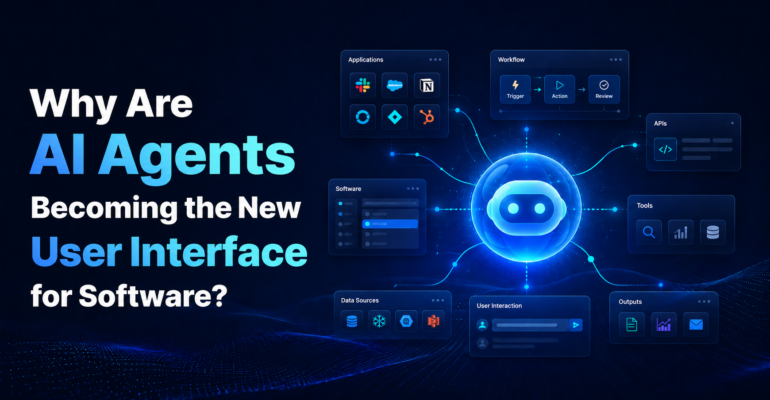
Why Are AI Agents Becoming the New User Interface for Software?
 Brainiuminfotech
 In 2025 and 2026, some of the world’s largest technology companies stopped treating AI agents as experiments and started building infrastructure around them. In 2025 alone, new standards for agent communication, tool access, and even autonomous purchasing emerged within months of each other, signaling something bigger than another interface trend.
The common explanation is that software is moving from clicking to chatting. But that framing is too narrow.
The deeper shift is that people increasingly express outcomes instead of manually operating applications. In response, software is beginning to expose capabilities that autonomous systems can discover, understand, and act upon directly. The interface is no longer only what appears on a screen. Increasingly, it is also the invisible layer that allows an agent to work on a user’s behalf.
In other words, AI agents are becoming software’s new interface because people are increasingly describing what they want done rather than navigating applications step by step. To support that shift, software companies are building machine-readable layers of APIs, permissions, and protocols that let agents understand, access, and safely act on a user’s behalf.
Key Takeaways
- AI agents shift software interaction from operating screens to specifying goals.
- Modern software increasingly requires both human-facing and machine-facing interfaces.
- Protocols such as MCP and A2A are becoming foundational infrastructure for agent interactions.
- Applications are gradually becoming services that agents can navigate on behalf of users.
- Successful software products will need to optimize for both human experience and agent accessibility.
What Does “AI Agents as the New UI” Actually Mean?
The phrase “AI agents are the new user interface” can be misleading because most people immediately picture a chat window. But the shift runs deeper than conversational software. What’s changing is where the work happens. Instead of users navigating applications and stitching together workflows themselves, software is increasingly taking responsibility for figuring out how to get from a goal to an outcome.
That distinction becomes clearer once you separate three ideas that often get lumped together.
A chatbot is primarily conversational. It answers questions, generates content, and responds to prompts, but it generally waits for instructions and has limited ability to do anything outside the conversation itself.
An AI agent adds action to the equation. It can retain context, reason through tasks, use tools, and carry out a series of steps with some degree of autonomy. The objective is not simply to produce an answer; it is to make progress toward a result.
An agentic interface is the broader experience built around that capability. The user no longer has to translate an objective into a sequence of screens, forms, and actions. Instead, the system takes on much of the coordination work while the human sets direction, reviews progress, and steps in when judgment or approval is needed.
| Traditional GUI | Conversational AI | Agentic Interface | |
| How intent is expressed | Clicks, forms, menus | Natural language prompts | Goals and standing permissions |
| Who performs actions | Human | Human with suggestions | Agent within defined limits |
| Memory | Minimal | Limited | Persistent and contextual |
| What sits underneath | Screens and workflows | Single model interactions | Protocols, permissions, audit layers |
Seen this way, the chat box is almost beside the point. The bigger change is that software is beginning to understand objectives and coordinate work on a person’s behalf. The interface is no longer just what people see on the screen. It increasingly includes the systems that can interpret intent and safely turn it into action.
Why the Real Shift in AI Agents isn’t the Chat Box But the Protocol Layer Underneath
The visible chat interface is only the surface. The real change is the emergence of machine-readable protocols that allow agents to discover capabilities, communicate with systems, and complete tasks without custom integrations or constant human intervention. Software is beginning to expose itself not only through screens designed for people but also through interfaces that machines can understand and use.
For most of computing history, software interaction followed a straightforward pattern. A person read the interface, decided what needed to happen next, clicked through screens or filled out forms, and the application responded to those individual actions.
An agent-driven experience works differently. An agent can discover available capabilities, obtain permissions, coordinate actions across systems, and execute tasks while the human primarily supervises outcomes and steps in when necessary.
The difference may seem subtle, but it changes where the interface actually lives. In traditional software, the screen is the interface because humans have to translate intentions into actions. In agent-driven systems, some of that translation work shifts to the agent itself. The interface increasingly includes the invisible layers that tell an agent what it can do, how it can do it, and what boundaries it must operate within.
That is why a growing protocol stack is emerging specifically for agent interactions.
| Protocol | Built By | Connects | Why It Matters |
| MCP (Model Context Protocol) | Anthropic; now under Linux Foundation | Agents to tools and data | Creates a standardized access layer between agents and external systems |
| A2A (Agent2Agent) | Agent to agent | Enables agents from different vendors to collaborate and hand off work | |
| AG-UI | Open ecosystem with Microsoft support | Agent backend to frontend | Standardizes how agent actions and state are rendered in real time |
| ACP/AP2/UCP | OpenAI + Stripe / Google / Google + Shopify | Agent to payments and commerce | Enables agents to complete transactions with verifiable authorization |
These protocols matter because they solve a problem that has long limited software interoperability. Historically, every integration required custom engineering and every application spoke its own language. The emerging protocol layer gives agents shared rules for discovering capabilities, accessing systems securely, and exchanging information predictably.
A useful way to think about this is through transportation. Early self-driving cars had to navigate roads designed entirely for human drivers. Today’s AI agents face a similar challenge. Most software was built for people to read and operate manually. The industry is now starting to build the digital roads that agents themselves can navigate.
When an agent can discover capabilities, take action, and prove authorization without a human navigating a screen, the protocol layer itself becomes the interface.
Why are AI Agents Becoming Popular Now? Four Forces are Converging
The protocol layer is important because it solves a problem that the industry suddenly needs to solve at scale. AI agents are gaining momentum because several conditions that were missing just a few years ago have arrived at the same time. Models have become more capable, connecting agents to software has become easier, businesses are under pressure to adopt agent-driven experiences, and the infrastructure required for agents to complete real-world transactions is finally emerging.
I. Model capabilities crossed a threshold
Modern models can now combine reasoning, memory, and tool use well enough to handle multi-step tasks with relatively light supervision. According to Google, agentic systems can plan, use tools, and adapt actions based on changing information rather than simply generate responses.
II. Integration costs collapsed
Connecting an agent to external tools no longer requires building custom integrations for every application. Thousands of MCP servers have emerged within a short period, turning what was once an engineering project into an increasingly standardized approach to tool access.
III. Economic pressure increased
Businesses are no longer asking whether agents will become part of software. They are asking how quickly they need to adapt. Gartner predicts that by the end of 2026, a significant share of enterprise applications will include task-specific AI agents, putting pressure on software vendors to become more agent-accessible.
IV. Commerce infrastructure arrived
One of the biggest limitations of early agents was that they could recommend products but rarely complete transactions. New initiatives such as ACP, AP2, and UCP are introducing frameworks for authorization and payment, turning agent-driven commerce from an interesting demo into deployable infrastructure.
Why 2025-2026 Feels Different
- Capable models can now reason through multi-step tasks and use external tools.
- Standardized protocols are making software increasingly accessible to agents.
- Enterprise demand is pushing software companies to expose machine-readable capabilities.
- Payment and authorization frameworks are allowing agents to participate in real transactions.
None of these developments would be transformative on their own. Together, however, they are creating the conditions for a new kind of software experience, one where agents are increasingly able to understand, coordinate, and act rather than simply answer questions.
Why is Modern Software Splitting into Two Interfaces for Humans and AI Agents?
The forces driving AI agents are also reshaping how software itself is designed. Modern applications increasingly have two interfaces operating at the same time: one built for people and another built for agents. Humans remain responsible for setting goals, reviewing outcomes, and handling exceptions, while machine-facing layers expose permissions, capabilities, and actions that agents can use directly.
A useful comparison comes from autonomous vehicles. The first self-driving cars had to navigate roads that were designed entirely around human drivers and human decision-making. Over time, the conversation shifted from making cars better at behaving like humans to building infrastructure that better supports autonomous systems.
Software is entering a similar phase.
For decades, applications were built around human navigation. Menus, dashboards, forms, and workflows existed because people needed ways to discover information and manually execute tasks. Agents, however, do not need to read a dashboard or search through settings menus. They need clearly defined capabilities, permissions, and rules of engagement.
You can think of modern software as having two layers:
I. Human Layer
- Goals and instructions
- Reviews and approvals
- Exceptions and judgment calls
- Trust and accountability
II. Machine Layer
- Protocols and APIs
- Permissions and identity controls
- Audit trails and verification mechanisms
- Transactions and system actions
This does not mean screens are disappearing. It means their role is changing. Increasingly, the human-facing interface becomes a place for supervision and decision-making, while the machine-facing interface becomes the operational layer where work is discovered, coordinated, and executed.
The most important interface in many applications may soon be the one users never directly see.
Why AI Agents are Creating an Entirely New UX Design Discipline
Once software can plan, take actions, and make decisions within defined boundaries, interface design stops being a problem of navigation. The question is no longer, “How do I help someone use this application?” It becomes, “How do I help someone stay in control of a system that is doing work on their behalf?” That is why designing for AI agents is emerging as a distinct UX discipline rather than an extension of chatbot design.
Traditional software experiences were relatively predictable. People provided instructions, the system responded, and the interaction ended. Agent-driven experiences are messier. A person starts with a goal, the system develops a plan, carries out multiple actions, encounters new information, and occasionally needs guidance along the way. The interface has to make that process understandable without overwhelming the user.
That changes the design priorities entirely:
I. Show enough of the reasoning instead of every detail
People rarely need to see an agent’s entire chain of thought, but they do need to understand why a recommendation was made or why a particular action was taken.
II. Make intervention feel natural
Stopping an agent should not feel like hitting an emergency brake. Good experiences allow people to redirect priorities, add constraints, or change their minds while work is in progress.
III. Treat uncertainty as information
Human experts regularly say, “I’m not completely sure.” Agents should do the same. Confidence signals help users decide when to trust automation and when to pay closer attention.
IV Design for recovery instead of perfection
Agents will misunderstand requests and occasionally head in the wrong direction. The experience should make correction easy because real-world work is rarely linear.
V. Assume goals will evolve
Someone planning a trip may suddenly change destinations. Someone preparing a report may add new requirements halfway through. Agent experiences need to absorb changing intent instead of forcing people to start over.
VI. Resist designing for demos
A five-minute demonstration usually involves clean instructions and obvious objectives. Real users are vague, contradictory, and prone to changing their minds. Designing for those messy moments is where agent UX actually begins.
In many ways, the future of UX may involve fewer screens and more stewardship. The challenge is no longer helping people navigate software. It is helping people understand, trust, and govern autonomous behavior.
When Do Humans Still Need a Screen in an AI Agent World?
The more capable AI agents become, the more valuable certain moments of human involvement actually become. Agents can remove a great deal of interface friction, but they cannot remove responsibility. There are still situations where people want to slow down, look more closely, and make the final call themselves.
Those moments tend to follow a pattern:
I. When the stakes are difficult to undo
People may let an agent reorder office supplies without a second thought. They are far less likely to delegate signing a contract, approving a six-figure payment, or making an important healthcare decision.
II. When judgment matters more than efficiency
Choosing a strategic direction, evaluating creative work, or deciding between competing priorities often involves intuition, taste, and trade-offs that are hard to reduce to rules.
III. When trust needs to be established or repaired
The first time an agent books a trip or manages a purchase, people usually want visibility into what it is doing. They also want that visibility after something goes wrong.
IV. When accountability cannot be delegated
Many industries still require a person to review, approve, or formally sign off on decisions, regardless of how much preparation an agent can automate.
V. When reality refuses to follow the script
Unexpected exceptions are where humans still excel. Conflicting information, unusual requests, and changing circumstances often require someone to interpret context rather than simply execute instructions.
This is why the future of software is unlikely to be screenless. In many applications, the interface will appear precisely at the moments that matter most. People will spend less time operating software and more time exercising judgment over it. Agents do not remove the graphical interface. They change when humans enter the workflow.
What Does an AI Agent Future Mean for Companies That Build or Sell Software?
If software is increasingly serving both people and autonomous systems, then product design has to account for both audiences. Building for an agent-first future means making products intuitive for humans while also making capabilities, permissions, and actions understandable to machines.
For years, software companies competed largely on interface quality. The assumption was simple: people would discover the product, learn how to navigate it, and manually complete every task themselves. That assumption is starting to change. As agents take on more execution work, products may increasingly compete on how easily they can be understood, accessed, and acted upon by autonomous systems.
That shift introduces a new set of priorities:
I. Make your data readable without your interface
Many products still depend on people interpreting dashboards, menus, and visual cues. Agents work differently. Structured, machine-readable information increasingly becomes part of the product itself.
II. Think beyond APIs and expose capabilities deliberately
The question is no longer only whether another application can connect to your product. Increasingly, it is whether an agent can discover what your product does and determine how to use it safely.
III. Treat authorization as a core experience
Autonomous systems need clear boundaries. Knowing who granted permission, what actions are allowed, and when additional approval is required may become just as important as the functionality itself.
IV. Design for oversight instead of constant interaction
If agents are doing more of the operational work, interfaces need to excel at surfacing progress, highlighting exceptions, and giving people confidence in what is happening behind the scenes.
Start measuring agent traffic separately. Some future customers may never visit your homepage or click through your navigation. Their first interaction with your product could happen through an agent acting on their behalf.
V. Document capabilities for machines instead of just developers
Agent-ready products increasingly need metadata, descriptions, and instructions that autonomous systems can interpret directly rather than infer from documentation written solely for humans.
VI. Treat interoperability as a product feature
Protocol support, discoverability, and secure access are gradually becoming part of the user experience itself. The easier it is for agents to understand and use your product, the more valuable that product becomes within an agent ecosystem.
In the agent era, discoverability may depend as much on whether an agent can understand and use your product as on whether a human can find it.
In Conclusion,
The next interface shift is not about replacing buttons with chat boxes. It is about moving from software that waits for instructions to software that can understand objectives and coordinate work on a person’s behalf.
As that happens, applications are increasingly being rebuilt with two interfaces at once. One remains human-facing, designed for judgment, oversight, and exceptions. The other is machine-facing, exposing capabilities, permissions, and actions that autonomous systems can navigate directly.
In many ways, applications are becoming infrastructure. Their value will depend not only on what people can do inside them but also on how easily agents can discover, understand, and interact with them.
The companies that thrive in this transition may not simply build better dashboards. They may build products that agents can understand, trust, and safely act upon without requiring a human to translate every step.
As software evolves to serve both people and AI agents, businesses need systems built for intelligence, interoperability, and trust. Explore Brainium’s AI solutions to see how we help organizations design and develop AI-powered products for the next generation of software.
Frequently Asked Questions
1. What does it mean that AI agents are becoming the new user interface?
AI agents are becoming the new user interface because people increasingly express goals instead of manually operating software step by step. Rather than navigating menus and workflows, users can delegate tasks to systems that plan, coordinate actions, and work toward outcomes. The interface shifts from being primarily a screen for interaction to a system that can understand intent and act on it safely.
2. What is the difference between a chatbot and an AI agent?
A chatbot primarily responds to prompts and generates information within a conversation. An AI agent goes further by maintaining context, using tools, interacting with external systems, and carrying out multi-step tasks with some degree of autonomy. In simple terms, a chatbot answers questions, while an AI agent works toward accomplishing an objective.
3. Why are AI agents becoming popular now?
AI agents are gaining momentum because several conditions have matured simultaneously. Modern AI models can reason and use tools more effectively, integration standards are reducing the effort required to connect systems, and businesses are under pressure to automate increasingly complex work. At the same time, new payment and authorization frameworks are making real-world agent actions more practical and trustworthy.
4. Are AI agents going to replace traditional apps entirely?
AI agents are unlikely to replace traditional applications completely. Many tasks still require screens for trust, oversight, approvals, and complex decision-making. Instead, software is evolving into a combination of human-facing and machine-facing interfaces. People will spend less time navigating applications directly, but traditional interfaces will continue to play an important role when judgment and accountability matter.
5. What is MCP and why does it matter for AI agents?
Model Context Protocol (MCP) is an open standard that allows AI agents to connect with tools, data sources, and external systems using a common approach. It matters because it reduces the need for custom integrations and makes capabilities easier for agents to discover and use. In many ways, MCP is helping establish the infrastructure that agent-driven software experiences depend on.
6. How do AI agents make purchases on someone’s behalf?
AI agents make purchases by combining product discovery with authorization and payment frameworks that verify what actions they are permitted to take. Instead of simply recommending products, agents can compare options, complete transactions, and follow predefined spending rules or approval requirements. The goal is not unrestricted autonomy but the ability to act within clearly defined permissions.
7. Will AI agents make UI/UX design obsolete?
AI agents are not making UI and UX design obsolete; they are changing what good design looks like. Interfaces increasingly need to communicate how autonomous systems are acting, when people should intervene, and how confidence or uncertainty should be interpreted. The challenge is becoming less about helping users navigate software and more about helping them understand and govern automated behavior.
8. Is it safe to let an AI agent act autonomously?
Allowing AI agents to act autonomously can be safe when clear boundaries, permissions, and oversight mechanisms are in place. Most agent systems work best when they operate within defined limits and escalate important decisions to people. The real question is usually not whether autonomy is safe, but which tasks are appropriate to delegate and where human supervision should remain.
9. How can businesses prepare their software for AI agents?
Businesses can prepare for AI agents by making their products usable by both people and autonomous systems. This often involves structuring data, exposing machine-accessible capabilities, implementing secure authorization layers, and redesigning experiences around supervision rather than manual navigation. For organizations exploring this transition, partners like Brainium Information Technologies help design and develop AI solutions that are intelligent, interoperable, and ready for an increasingly agent-driven software landscape.