Why AI-Readable Shopify Stores Will Outperform AI-Optimized Ones
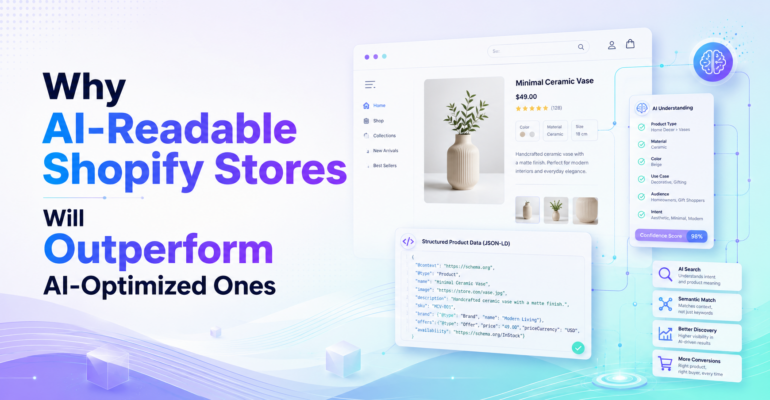
Why AI-Readable Shopify Stores Will Outperform AI-Optimized Ones
 Brainiuminfotech
 For years, Shopify merchants have optimized their stores around the simple assumption that if the right customer finds the right product page, the sale can happen. That assumption shaped everything.
Stores were built to rank for searches, convert visitors, and guide human shoppers from discovery to checkout. Product pages focused on persuasion. Collections focused on navigation. SEO focused on helping search engines understand relevance.
But AI-powered shopping introduces a different challenge.
The next generation of product discovery will not always begin with a customer browsing ten tabs or comparing dozens of products. Increasingly, AI systems will act as the layer between shoppers and stores by interpreting needs, evaluating options, and deciding which products are worth recommending.
Compare these two:
Traditional search: “best hiking backpack”
AI-driven shopping: “I need a waterproof backpack for a 5-day Himalayan trek, under $200, with enough support for someone with back problems.”
The second query is not looking for keywords. It requires understanding relationships between products, situations, preferences, limitations, and alternatives.
This changes what ecommerce optimization means.
For businesses planning to future-proof their ecommerce strategy, whether they’re refining an existing store or looking to hire Shopify developers in India to build one from the ground up, AI readability is becoming a design consideration rather than an afterthought.
The future winners will not simply have AI-optimized Shopify stores. They will have AI-readable stores whose products, content, and business information are structured so AI systems can understand, trust, and recommend them.
What is the Difference Between an AI-Optimized and AI-Readable Shopify Store?
As AI becomes part of product discovery, a new distinction is emerging: being visible to AI systems is not the same as being understood by them.
Most discussions around AI optimization focus on helping a store show up in AI-powered search results. That usually means making product information easier to access, strengthening structured data, and ensuring platforms have the signals they need to understand what a store contains.
AI readability goes beyond visibility.
It focuses on whether AI systems can make sense of what a store offers and understand when a product is relevant for a specific need.
| AI Optimization | AI Readability | |
| Primary goal | Improve visibility in AI-powered search | Help AI understand and evaluate products |
| Focus | Discovery signals | Meaning and interpretation |
| Optimizes for | Being found | Being recommended |
| Success looks like | Your products appear in results | AI can confidently explain product relevance |
| Core question | “Can AI find my store?” | “Does AI understand my store?” |
The difference is simple: AI optimization helps systems retrieve information while AI readability helps systems make sense of it.
As ecommerce moves toward AI-assisted shopping, Shopify stores will need to compete not only for visibility but also for machine understanding.
Why Traditional Shopify Optimization Solved Yesterday’s Problem
Most Shopify stores have spent years answering one question: “Will this convince a customer to buy?”
It’s the question behind almost every optimization decision, from product copy and landing pages to SEO and conversion testing.
What’s rarely asked is a different question: “Would this help someone explain the product to another person?”
Until recently, that distinction didn’t matter. Search engines were responsible for finding relevant pages, not interpreting them. As long as a shopper landed on the product page, the copy, images, reviews, and specifications could work together to make the sale.
AI-assisted commerce changes the audience of that information.
Before a customer reads your product page, an AI may already have summarized it, compared it with competing products, or decided whether it’s worth recommending at all.
| Traditional Shopify Optimization | AI-Assisted Commerce |
| Information is written to persuade the shopper | Information must also support AI evaluation |
| The customer performs the comparison | AI increasingly performs the first comparison |
| Success depends on winning the click | Success increasingly depends on earning the recommendation |
Traditional optimization still matters. But it was built for a world where people did all the interpretation themselves. AI introduces a second audience that doesn’t respond to persuasive copy or polished design but only to information it can reliably understand and use.
Why the Best Shopify Product Pages Answer Questions Before They’re Asked
Open almost any Shopify store and you’ll notice a familiar pattern.
- Products are premium.
- Materials are high quality.
- Designs are thoughtfully crafted.
- Performance is best in class.
There’s nothing inherently wrong with that language. It’s designed to sell. But ask a different question: How many product pages tell you when a product isn’t the right choice?
Very few.
Most product pages explain what a product is and why it’s worth buying. They rarely explain where it performs best, what trade-offs come with choosing it, or who might be better served by an alternative.
That missing information hasn’t been a major problem because shoppers have always found other ways to fill the gaps. They compare competing products, browse reviews, watch YouTube videos, or ask questions in forums before making a purchase.
An AI assistant doesn’t follow that journey in quite the same way. It builds its recommendation from the information available to it. If the product page leaves important questions unanswered, AI is left making assumptions, or avoiding them altogether.
That’s why the next generation of Shopify product pages won’t stand out because they use better marketing language. They’ll stand out because they reduce uncertainty. Instead of leaving customers (or AI) to connect the dots, they’ll answer the questions that usually send buyers searching somewhere else.
The Five Questions Every AI-Readable Shopify Store Should Be Able to Answer
The previous sections explain why AI-readable stores are different. The next question is more practical: what information actually helps AI recommend one product over another?
The answer isn’t hidden in a single piece of metadata or another block of AI-generated copy. It comes from reducing the uncertainty that surrounds every buying decision. The more clearly a Shopify store answers the questions below, the easier it becomes for AI to understand not just what a product is, but why it deserves a recommendation.
1. Can AI understand what problem the product solves?
Every product has two identities: what it is and what it solves.
Most Shopify stores do a good job of documenting the first. Dimensions, materials, technical specifications, and product variants are usually easy to find. What’s often missing is the context around those details. Why would someone choose this product? What situation was it designed for? Where does it perform best?
Without those answers, AI sees a list of attributes rather than a solution.
To build that understanding, stores should clearly communicate:
- Primary use cases
- Materials and specifications
- Available variations
- Compatibility with related products
- Practical limitations
2. Can AI identify who the product is for?
A detailed product description doesn’t automatically tell AI who the product was built for.
Take these examples:
Running shoes
Running shoes for beginners training on concrete roads three times a week
The second description instantly narrows the audience. It tells AI far more than the product category ever could because it connects the product to a specific type of buyer and a specific use case.
That clarity often comes from details such as:
- User type
- Experience level
- Typical environment
- Primary goal
The more precisely a store defines its intended customer, the fewer assumptions AI has to make.
3. Can AI explain why someone should choose this product?
Features describe a product. Recommendations require reasoning.
If two products have similar specifications, AI still needs evidence for why one is the better fit. That reasoning often comes from information many product pages overlook:
- Meaningful advantages
- Trade-offs buyers should know
- Comparable alternatives
- Situations where another option may be more suitable
These distinctions don’t weaken a product page. They make recommendations more credible because they acknowledge that every product has strengths as well as boundaries.
4. Can AI verify that the business behind the product is trustworthy?
A recommendation carries a degree of responsibility. Whether it’s a person or an AI making that recommendation, trust matters.
That’s why AI also considers signals beyond the product itself. Clear return policies, warranty information, customer reviews, certifications, and evidence of brand expertise all help establish confidence that a recommendation is unlikely to create a poor customer experience.
Trust isn’t separate from product information anymore. It’s part of the recommendation itself.
5. Can AI connect information across the store?
The answers buyers need rarely live on a single page.
A buying guide explains the use case. The FAQ addresses common concerns. The product page covers specifications. A blog post compares alternatives.
Viewed individually, each page answers only part of the question. Viewed together, they create a complete picture.
The strongest Shopify stores don’t just publish useful content. They connect it. When information across product pages, buying guides, FAQs, collections, and support content reinforces one another, AI has a much stronger foundation for generating accurate recommendations.
Ultimately, AI readability isn’t about adding more information to a Shopify store. It’s about making the existing information complete enough that neither buyers nor AI have to guess.
Why Connected Information Will Define the Next Generation of Shopify Stores
The five questions in the previous section rarely have a single source.
A product page may explain what a product does, but a buying guide explains when to choose it. An FAQ addresses common concerns, while a comparison article explains how it differs from similar options. Together, these pieces answer the questions shoppers ask before making a purchase.
The same is true for AI.
Rather than treating every page as an independent destination, AI combines information from across a store to understand how products, customer needs, and supporting content relate to one another.
Consider a hiking boot. AI may connect it with:
- Long-distance trekking
- Rocky or wet terrain
- Hikers who need extra ankle support
- Waterproof care instructions
- Alternative trail shoes for warmer conditions
None of these relationships has to appear on a single page. They simply need to be consistent wherever they’re mentioned.
This is the principle behind what computer scientists call a knowledge graph. It is basically a network of connected information that creates a clearer understanding than any individual page can provide. As AI-powered shopping evolves, that connected understanding will become just as important as the quality of the pages themselves.
Why More Content Alone Won’t Make Shopify Stores AI-Readable
One of the first reactions to AI-powered commerce will be to publish more content.
More buying guides. More FAQs. More comparison pages. More AI-generated articles.
That isn’t necessarily the wrong move. The problem is that many stores will create new pages before identifying what information is actually missing.
Imagine a customer trying to decide between two hiking backpacks. If the store already explains capacity, materials, and pricing, another blog on “Best Hiking Backpacks of 2026” adds very little. A guide explaining which backpack is better for weekend trips versus multi-day treks fills a genuine gap in understanding.
The difference is subtle but important. One page exists because there’s another keyword to target. The other exists because there’s another buying question to answer.
That’s the standard AI increasingly rewards. Every new page should contribute something the store couldn’t explain before instead of simply increasing the amount of content it publishes.
In practice, the most AI-readable Shopify stores won’t be the ones with the largest content libraries. They’ll be the ones where every page has a clear purpose in helping shoppers understand, compare, or choose a product.
Can Your Shopify Store Pass an AI Readability Check?
By now, the idea of AI readability should feel less abstract. The challenge is knowing whether your own store meets that standard.
A quick way to test it is to pick any product in your store and work through the questions below. If several answers are “no,” you’ve found the gaps that AI (and often customers) will struggle with too.
I. Product Page
- Can a first-time visitor understand what problem this product solves within a few seconds?
- Does the page explain when someone shouldn’t choose this product?
- Are important specifications connected to real-world use cases rather than listed on their own?
II. Customer Fit
- Is it obvious who this product was designed for?
- Would two different customer types understand which one it suits best?
III. Decision Support
- Does the page explain how this product differs from similar options you sell?
- Can a shopper understand the trade-offs without leaving your website?
IV. Trust
- Are returns, warranties, delivery information, and customer reviews easy to find?
- Does the store demonstrate experience or expertise beyond marketing claims?
V. Store-Wide Consistency
- Do your buying guides, FAQs, and product pages tell the same story?
- If AI compared those pages, would they reinforce each other or create conflicting signals?
The Next Shopify Advantage Will Be Machine Understanding
For years, Shopify success depended on attracting visitors and convincing them to buy. That foundation isn’t going away, but AI-powered commerce adds another layer to the buying journey. Before a customer ever reaches a product page, an AI assistant may already have compared products, filtered options, and decided which stores are worth recommending.
That shift raises a different standard for ecommerce content. It’s no longer enough for information to exist. It has to be specific, connected, and complete enough that AI can explain why a product fits a particular need instead of simply describing what it is.
The stores that adapt first won’t necessarily have the most pages or the most AI-generated content. They’ll have fewer gaps in the information buyers need to make confident decisions.
The next competitive advantage for Shopify brands won’t come from optimizing only for search rankings. It will come from becoming the store that AI understands well enough to recommend with confidence.
Ready to build an AI-readable Shopify store? Brainium helps businesses create future-ready ecommerce experiences. Whether you’re launching a new store or looking to hire Shopify developers in India, our team can help you stay ahead of the next wave of AI-powered commerce.
Frequently Asked Questions
1. What makes a Shopify store AI-readable?
An AI-readable Shopify store gives AI enough context to accurately understand, compare, and recommend its products. That means combining clear product information with customer context, use cases, limitations, comparisons, and consistent information across the store.
2. Can AI read Shopify product pages?
Yes, but only the information available to it. Product pages that explain who a product is for, where it performs best, and its trade-offs are easier for AI to recommend than pages built mainly around marketing claims.
3. Does structured data make a Shopify store AI-ready?
No. Structured data helps AI identify product details such as price, availability, and ratings, but it doesn’t explain why a product fits a particular customer or use case. AI readiness requires both structured data and meaningful product context.
4. What information helps AI recommend products?
AI recommendations become more reliable when a store explains:
- Who the product is for
- The problem it solves
- Primary use cases
- Key specifications
- Product limitations
- Comparable alternatives
- Trust signals such as reviews and warranties
5. Should Shopify stores create more content for AI?
Not necessarily. AI benefits more from information that fills knowledge gaps than from a larger volume of content. A useful comparison guide or buying guide often adds more value than multiple articles targeting similar keywords.
6. Will AI replace Shopify SEO?
No. SEO helps AI and customers discover your store, while AI readability helps AI understand and recommend your products. Both will become essential as AI-powered shopping grows.
7. What’s the biggest mistake businesses make when optimizing Shopify stores for AI?
Treating AI optimization as a content production exercise. Publishing more pages won’t improve recommendations if important buying information is still missing or inconsistent across the store.