
What Does It Take to Engineer an AI Agent?
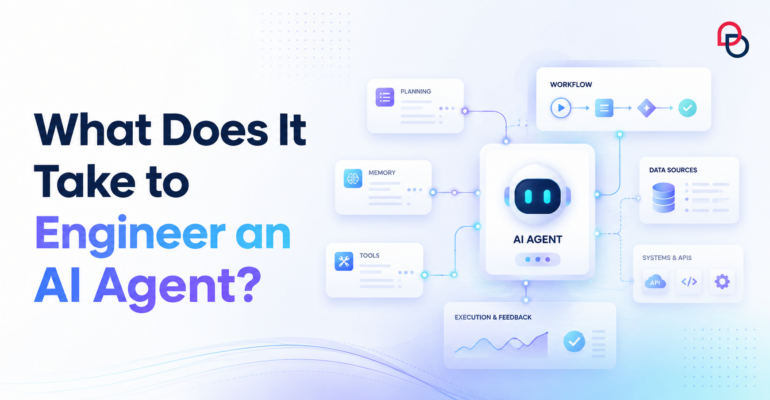
What Does It Take to Engineer an AI Agent?
 Brainiuminfotech
 An AI agent can look deceptively simple from the outside. Give it a goal, let it reason through the task, connect it to a few tools, and it appears ready to work.
But getting an AI model to produce a convincing response is very different from engineering a system that can actually operate.
A model can answer a question. An AI agent needs to work toward an outcome. It may need to retrieve information from a company database, decide which system to use, call an API, interpret the result, take another action, and know when the task is complete. If something goes wrong along the way, it also needs a way to recover or hand the task back to a person.
That is where AI engineering begins.
The difficult part isn’t simply choosing a capable model. It’s designing everything around that model so the agent has the right information, access, decision-making logic, controls and feedback to do its job reliably. In other words, the intelligence may come from the model, but the ability to put that intelligence to work comes from the engineering.
So what does it actually take to build an AI agent that can move beyond a demo and operate inside a real business? The answer starts with understanding what makes an agent fundamentally different from an AI feature.
What Makes an AI Agent Different From an AI Feature?
That distinction becomes clearer when you look at what happens after the AI produces its first output.
With a conventional AI feature, the path is usually known in advance. A user triggers the feature, the AI performs a specific task, and the application takes over from there. The boundaries are relatively clear because the software already knows what should happen next.
An agent introduces uncertainty into that path. It may need to decide which information is relevant, which action to take, whether another step is necessary, or whether it has enough information to complete the task. The software can no longer assume that every interaction will follow exactly the same sequence.
That difference is small from a user’s perspective but significant from an engineering perspective.
Consider an internal sales assistant.
A simple AI feature could summarise a sales call. An agent tasked with preparing a follow-up might need to –
- Review the conversation
- Check the customer’s CRM record
- Identify open opportunities
- Draft a suitable response
- Create a follow-up task
The challenge is no longer just generating good text. The system has to give the AI enough information and access to the right capabilities while still keeping the process within defined boundaries.
This is the shift from adding AI to a workflow to engineering a workflow in which AI can make decisions. And once the agent has to operate across information, software and actions, the surrounding engineering becomes just as important as the model itself.
What Does an Agent Need to Operate in the Real World?
An agent rarely gets to work with a neat, self-contained pool of business information. In a real organisation, the information it needs is usually spread across systems that were built for different purposes and at different times.
A customer record might live in a CRM, order information in an ERP, product details in another system, and the company’s policies in a collection of documents. Some information may be current while some may not. Different systems may even disagree.
That makes integration more than a technical connection between an AI model and an API. The engineering team has to decide which sources the agent can trust, how information should be retrieved, and what should happen when the information it finds is incomplete or conflicting.
This is one reason AI agents can’t simply be dropped into an existing software environment. They need an interface with that environment that accounts for how the business actually stores, manages and uses information.
Once an agent has been given that access, the engineering question becomes much more important: how much authority should it have over those systems?
Why Does Giving an Agent Access to Tools Change the Engineering Challenge?
The engineering challenge changes once an agent moves from understanding a situation to doing something about it.
An AI model can make a judgment such as, “This customer appears eligible for a refund.” But a refund system cannot act on that judgment alone. It needs a verified order, a valid amount, the right permissions and a clear set of rules for when the transaction can proceed.
That creates a boundary between two very different kinds of systems:
| AI Agent | Business Software |
| Interprets the situation | Validates the required data |
| Decides what should happen | Checks whether the action is permitted |
| Selects a tool or action | Executes it according to defined rules |
The agent therefore shouldn’t be treated as having direct, unrestricted control over every system it can reach. Its tools need well-defined interfaces, appropriate permissions and ways to handle invalid requests or failed actions.
This is also why adding more tools isn’t automatically an improvement. Every new capability creates another point where an AI decision has to be translated into a controlled software action.
The real engineering question is no longer simply “What can the agent do?” It is “What should it be trusted to do on its own?”
How Do You Decide What an Agent Should Be Allowed to Do?
Once an agent can take action, more freedom isn’t automatically better. The level of autonomy should depend on what happens if the agent gets the decision wrong.
An agent checking whether an order has shipped can usually work independently. An agent deciding whether to issue a $5,000 refund is a different proposition, even if both actions involve the same systems.
A practical autonomy spectrum looks like this:
- Assist: Gather information or prepare work for a person.
- Recommend: Suggest a decision for someone to review.
- Act with approval: Prepare a consequential action that requires sign-off.
- Act independently: Complete defined, low-risk actions without intervention.
The same agent can operate at different levels within one workflow. It might check an order independently, recommend a resolution and require approval for an unusual refund.
The useful measure of autonomy isn’t how much an agent can do, but how much it should do without someone checking its work.
Even with sensible boundaries, an agent will sometimes encounter a situation it gets wrong or cannot resolve. That makes failure handling the next part of the engineering problem.
What Happens When the Agent Makes the Wrong Decision?
Even when an agent is given only the autonomy it can reasonably handle, it will still encounter situations it wasn’t designed for. A system response may be incomplete, a tool may fail, or the agent may choose an inappropriate next step.
The engineering challenge is deciding how far that mistake is allowed to travel.
A failed API call might be safe to retry. An uncertain recommendation might need human review. A potentially damaging action may need to stop immediately. These responses have to be designed into the system rather than left to the model to work out after something has gone wrong.
Reliable agents therefore need clear failure paths. They should be able to validate results, retry when appropriate, fall back to another method, or escalate when the task is beyond their limits.
The aim isn’t to eliminate every possible failure but to contain failures before they become larger ones.
That raises another practical challenge: if an agent is operating through hundreds or thousands of interactions, how do you know where its behaviour is breaking down?
How Do You Know an Agent is Reliable Enough to Use?
The first step is being able to see what happened.
For an agent, checking the final response isn’t enough. An unsuccessful task might have started with poor retrieval, a wrong tool choice or an unexpected result from an external system. A successful response can also hide inefficient or risky behaviour.
Evaluation therefore needs to look beyond the final output and examine how the agent reached it: what information it used, which actions it took, whether it followed the expected process and whether it achieved the intended outcome.
Observability makes that behaviour traceable in practice, giving engineers the evidence they need to find patterns, investigate failures and measure whether changes actually improve the system.
Without this visibility, agent development becomes guesswork. With it, reliability becomes something that can be tested, measured and improved over time.
What Changes When the Agent Becomes Part of a Production System?
A prototype has an endpoint. You reach a point where the agent completes the task well enough to demonstrate that the idea works.
Production doesn’t have the same endpoint. An agent becomes part of a system that will be changed, maintained and improved long after its initial release. The model may be replaced, prompts may evolve, tools may be added, and the business process itself may change. Each of those changes can affect how the agent behaves.
That makes the agent’s surrounding engineering important over its entire lifecycle. Teams need to know what changed, which version produced a particular result, whether a new model or prompt improves performance, and how to reverse a change when it doesn’t.
The shift is subtle but important: shipping an agent is not the end of the engineering work. It is the point at which that work becomes ongoing.
What Does it Actually Take to Engineer an AI Agent?
By now, the model itself almost feels like the easy part.
The difficult decisions sit around it: what the agent is responsible for, what it can access, which actions it can take without approval, and how the system behaves when reality doesn’t match what the developers expected.
A well-engineered agent therefore has to bring together:
- A job worth giving to an agent — A defined outcome rather than autonomy for its own sake.
- An environment it can work in — The right data, software and tools, with sensible boundaries.
- A level of independence that makes sense — Enough freedom to be useful, but not so much that a mistake becomes an avoidable business risk.
- A way to learn from its own behaviour — Evaluation and observability that reveal what is working and what isn’t.
- An engineering lifecycle — Testing, deployment, updates and maintenance after the initial build.
None of these decisions can be solved by choosing a better model alone. They require an understanding of the business process, the existing technology and the consequences of giving AI the ability to act within it.
That is ultimately what AI agent engineering is about. It’s not making AI autonomous for the sake of it, but making AI capable of useful, controlled action inside a real system.
Where AI Engineering Comes In
The gap between an AI agent that works in a demo and one that works reliably inside a business is an engineering problem.
That means working with the models, data, software and workflows already in place, and designing the agent around the realities of that environment.
That’s where Brainium’s AI engineering expertise can help. We work with businesses to turn AI agent concepts into practical, integrated solutions built for real-world use.
Have an AI agent idea worth engineering? Talk to Brainium.