How to Optimize Shopify Stores for AI-Driven Commerce in 2026
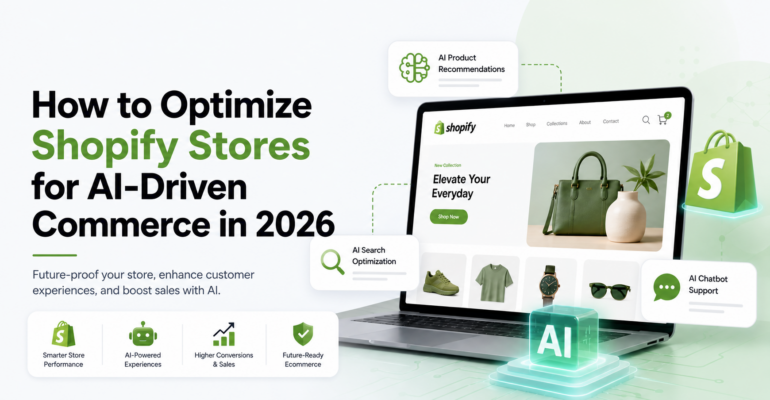
How to Optimize Shopify Stores for AI-Driven Commerce in 2026
 Brainiuminfotech
 Shopify store optimization for AI-driven commerce is rapidly becoming essential as artificial intelligence reshapes how consumers search, discover, and purchase products online. In 2026, Shopify merchants must optimize far beyond traditional SEO, design, and conversion tactics to remain competitive in a digital ecosystem increasingly influenced by conversational search, predictive analytics, AI-powered personalization, and automated merchandising.
Shopify’s own AI ecosystem, including Shopify Magic and Sidekick, combined with third-party tools now allows merchants to create smarter, adaptive storefronts that align with evolving customer expectations. AI is no longer an optional enhancement; it is becoming core ecommerce infrastructure.
This shift requires merchants to optimize Shopify stores not just for human shoppers, but also for AI search engines, recommendation algorithms, and digital buying assistants that influence product visibility and purchase behavior.
This guide explores the most effective strategies to future-proof Shopify stores for AI-first commerce success in 2026.
Quick Answer: How Do You Optimize a Shopify Store for AI-Driven Commerce?
To optimize a Shopify store for AI-driven commerce in 2026, merchants should strengthen product data structure, implement AI-powered personalization, enhance technical SEO, optimize for conversational and semantic search, deploy predictive analytics, and integrate AI-driven customer support solutions. Success depends on combining exceptional customer experience with machine-readable store architecture.
What AI-Driven Commerce Means for Shopify Stores
AI-driven commerce refers to the integration of artificial intelligence across ecommerce operations to automate, personalize, predict, and optimize the customer journey.
Key AI Applications for Shopify:
- Personalized product recommendations
- Predictive inventory forecasting
- AI-powered search experiences
- Dynamic pricing optimization
- Conversational shopping assistants
- Automated customer segmentation
- Smart merchandising strategies
For Shopify merchants, this represents a shift from static online storefronts to intelligent, data-driven ecosystems that continuously adapt based on user behavior, purchasing patterns, and market trends.
Why Shopify Merchants Must Prioritize AI Optimization in 2026
Artificial intelligence is no longer a future-facing innovation in ecommerce. It is actively reshaping how Shopify businesses compete, scale, and retain customers. As digital commerce becomes increasingly AI-first, merchants must adapt their stores to align with evolving consumer behaviors, search technologies, and competitive benchmarks.
In 2026, AI optimization is essential because it directly influences customer experience, discoverability, operational efficiency, and revenue growth. Shopify merchants that fail to adapt risk falling behind competitors that leverage smarter automation, personalization, and predictive intelligence.
1. Consumer Expectations Are Evolving
Today’s shoppers expect ecommerce experiences to feel faster, smarter, and more personalized than ever before. Generic storefronts are increasingly ineffective as consumers demand relevant interactions tailored to their needs.
Modern shoppers increasingly expect:
- Hyper-personalized product suggestions
- Faster product discovery
- Instant customer support
- Intelligent recommendations
- Seamless omnichannel experiences
AI empowers Shopify merchants to meet these expectations at scale through personalized recommendations, automated support systems, and adaptive shopping journeys.
2. Search Is Becoming More Semantic and Conversational
The way customers discover products is changing rapidly. Traditional keyword-focused search strategies are giving way to AI-powered systems that prioritize intent, context, and natural language.
Search engines and ecommerce platforms increasingly prioritize:
- AI Overviews
- Conversational search interfaces
- Voice commerce optimization
- Semantic relevance over keyword density
As a result, Shopify stores must optimize content, product pages, and metadata for machine interpretation, ensuring stronger visibility across AI-powered discovery systems.
3. Competitive Pressure is Rising
AI adoption is creating significant competitive advantages for ecommerce brands that move early.
AI-enabled competitors often achieve:
- Higher conversion rates
- Lower operational costs
- Better retention strategies
- Smarter merchandising decisions
- Improved revenue forecasting
Merchants who delay AI optimization may face reduced discoverability, weaker customer engagement, and declining competitiveness in increasingly automated ecommerce markets.
Core Strategies to Optimize Shopify Stores for AI-Driven Commerce
Successfully optimizing a Shopify store for AI-driven commerce in 2026 requires more than simply adding automation tools or improving surface-level SEO. Merchants must build an intelligent ecommerce ecosystem where product data, customer experiences, search visibility, and operational systems all work together to support AI-powered discovery and decision-making.
The most effective Shopify AI optimization strategies combine technical infrastructure with customer-centric enhancements, ensuring stores are visible, relevant, and competitive across both human and machine-driven commerce channels.
1. Strengthen Product Data for AI Search and Discovery
Product data is the foundation of AI commerce performance. Search engines, recommendation algorithms, voice assistants, and generative shopping platforms all rely on structured, detailed, and semantically rich information to understand and surface products effectively.
For Shopify merchants, this means moving beyond minimal product listings and creating machine-readable product ecosystems.
Key improvements include:
- Using semantically optimized product titles
- Writing detailed, context-rich product descriptions
- Leveraging Shopify metafields for structured information
- Implementing schema markup
- Adding FAQ sections to product pages
- Standardizing product categories and tags
- Optimizing image alt text
- Improving product variant consistency
For example, a generic title like “Blue Sneakers” provides limited contextual value, whereas “Men’s Lightweight Blue Running Sneakers with Breathable Mesh for Daily Training” significantly improves AI understanding.
Well-structured product data enhances:
- Semantic search visibility
- Voice commerce discoverability
- AI recommendations
- Marketplace integrations
- Conversational shopping assistants
In AI-first ecommerce, better data directly improves discoverability and conversion potential.
2. Implement AI-Powered Personalization
Personalization has become a critical driver of ecommerce performance, with AI enabling Shopify stores to tailor experiences in real time based on customer behavior, preferences, and purchase history.
Rather than offering static shopping experiences, AI-powered Shopify stores can dynamically adapt product recommendations, marketing messages, and user journeys to maximize relevance.
High-impact personalization strategies include:
- Behavioral recommendation engines
- Personalized homepage experiences
- Dynamic collection merchandising
- Smart upselling and cross-selling
- Segmented email automation
- Lifecycle-based customer targeting
Popular Shopify AI tools such as Shopify Magic, Sidekick, Klaviyo AI, Rebuy, and Nosto allow merchants to deploy personalization at scale.
Strategically implemented personalization can improve:
- Average order value
- Customer retention
- Repeat purchases
- Engagement metrics
- Conversion rates
As AI systems increasingly reward relevant customer experiences, personalization becomes both a conversion tool and a visibility advantage.
3. Optimize for Conversational Commerce
Conversational commerce is transforming how customers interact with online stores by integrating AI-driven communication tools directly into the shopping journey.
In 2026, Shopify merchants must prepare for customers who increasingly prefer natural language interactions over traditional browsing.
Effective conversational commerce strategies include:
- AI chatbots for 24/7 support
- Automated FAQ systems
- Product recommendation assistants
- Cart recovery automation
- Voice-search readiness
- Messaging platform integrations
Shopify’s ecosystem offers multiple opportunities here, including Shopify Inbox AI, GPT-powered support tools, and advanced customer service automation apps.
Conversational commerce benefits include:
- Faster customer decision-making
- Reduced bounce rates
- Higher customer satisfaction
- Better retention
- Improved scalability
As conversational interfaces become more central to ecommerce, Shopify stores optimized for natural language engagement will hold a stronger competitive position.
4. Use Predictive Analytics for Operational Efficiency
AI optimization is not limited to customer-facing improvements. It also transforms backend operations.
Predictive analytics helps Shopify merchants make proactive, data-driven decisions that improve efficiency, reduce waste, and maximize profitability.
Core predictive applications include:
- Demand forecasting
- Inventory planning
- Dynamic pricing
- Customer lifetime value prediction
- Churn prevention
- Marketing budget optimization
By leveraging predictive analytics, Shopify merchants can reduce:
- Overstocking
- Stock shortages
- Advertising inefficiencies
- Customer retention gaps
- Revenue loss
This operational intelligence supports sustainable scaling while improving financial performance.
In increasingly competitive markets, predictive optimization provides merchants with stronger resilience and profitability.
5. Strengthen Technical SEO for AI Visibility
Even in AI-powered commerce, technical SEO remains essential because AI systems still depend on crawlable, structured, and high-performance websites.
Shopify merchants must ensure their stores are optimized not only for traditional search engines but also for AI crawlers, semantic search systems, recommendation engines, and generative search interfaces.
Critical technical SEO priorities include:
- Core Web Vitals optimization
- Mobile-first design
- Page speed enhancements
- Schema implementation
- Clean site architecture
- Internal linking
- Semantic keyword clustering
- First-party data strategies
Technical SEO now serves as the infrastructure that supports:
- Search visibility
- AI discoverability
- Voice commerce readiness
- Personalized recommendations
- Conversational search relevance
Without strong technical SEO foundations, even advanced AI tools may underperform due to poor crawlability and weak data clarity.
What are the Best Shopify AI Tools for 2026
As AI becomes deeply integrated into ecommerce operations, Shopify merchants must carefully select tools that align with their business model, growth stage, and customer experience goals. In 2026, Shopify’s AI ecosystem extends far beyond basic automation, offering merchants access to advanced solutions for content generation, predictive analytics, personalization, customer retention, and semantic product discovery.
Rather than adopting AI tools indiscriminately, merchants should prioritize platforms that solve specific operational challenges while improving conversion rates, customer loyalty, and long-term scalability.
The most effective Shopify AI tools combine automation with strategic optimization, helping brands compete in increasingly intelligent digital marketplaces.
| Tool | Best For | Primary AI Function |
| Shopify Magic | Content generation | Product descriptions, email automation, workflow support |
| Sidekick | Store management | Strategic recommendations, analytics insights |
| Klaviyo AI | Marketing automation | Customer segmentation, personalized campaigns |
| Rebuy | Conversion optimization | Product recommendations, upselling |
| Yotpo AI | Loyalty + customer retention | Reviews, retention, loyalty automation |
| Search & Discovery | Product discoverability | Semantic search and intelligent merchandising |
How to Choose the Right Shopify AI Tools
Selecting the best AI stack depends on several strategic factors:
- Product catalog complexity
- Marketing maturity
- Customer lifecycle sophistication
- Retention priorities
- Revenue growth goals
- Budget flexibility
For example:
- Small businesses may prioritize Shopify Magic and Search & Discovery
- Growth-stage brands often benefit from Klaviyo AI and Rebuy
- Enterprise merchants may require advanced personalization platforms like Nosto or custom AI integrations
Thus, the best Shopify AI tools are not necessarily the most advanced. They are the ones that best align with business objectives, operational infrastructure, and customer experience strategies.
In AI-driven commerce, tool selection should support both immediate performance gains and future scalability.
Common Shopify AI Optimization Mistakes to Avoid
While AI presents significant growth opportunities, poor implementation can reduce performance, weaken customer trust, and create technical inefficiencies. Many Shopify merchants make the mistake of adopting AI reactively without establishing the foundational systems necessary for sustainable optimization.
AI is not a shortcut. It amplifies the quality of existing infrastructure.
Common High-Risk Mistakes Include:
- Thin or poorly optimized product descriptions
- Weak or missing schema markup
- Over-automation without human oversight
- Slow site speed
- Poor personalization strategy
- Fragmented customer data systems
- Underutilization of Shopify’s native AI capabilities
- Inconsistent product categorization
These mistakes matter a lot since poor AI optimization can result in:
- Reduced search visibility
- Lower conversion rates
- Weak recommendation accuracy
- Customer frustration
- Inefficient automation
- Missed revenue opportunities
Example:
A Shopify store using AI-generated product descriptions without human review may produce duplicate, vague, or semantically weak content that harms both SEO and customer trust.
Hence, successful Shopify AI optimization requires disciplined implementation, and not just automation adoption.
Future Trends Shaping AI-Driven Shopify Commerce
The future of Shopify commerce will be increasingly shaped by AI not simply as an operational tool, but as a central force driving product discovery, merchandising, customer engagement, and fulfillment.
As consumer behaviors evolve and search systems become more intelligent, merchants must prepare for a rapidly changing ecommerce ecosystem.
Key trends defining Shopify AI commerce in 2026 and beyond include –
- Voice Commerce Expansion – Consumers are increasingly using voice assistants and conversational interfaces to discover and purchase products.
- Visual Search Adoption – AI-powered image recognition allows customers to search using photos rather than text.
- AI Shopping Assistants – Personalized digital buying assistants are becoming more integrated into ecommerce ecosystems.
- Autonomous Merchandising – AI systems can increasingly optimize product placement, promotions, and recommendations without manual intervention.
- Predictive Fulfillment – AI helps brands anticipate purchasing patterns to improve inventory and shipping logistics.
- Headless Commerce with AI Layers – Custom storefronts integrated with advanced AI capabilities are becoming more common for scaling brands.
- Agentic Commerce Interfaces – AI agents may increasingly purchase, compare, and negotiate products on behalf of consumers.
AI is evolving into both internal optimization infrastructure and external customer acquisition and discovery channels. This means Shopify merchants must optimize for AI not only within their stores but also across broader digital ecosystems where AI influences purchasing behavior.
In Conclusion,
AI-driven commerce in 2026 is reshaping how Shopify stores compete, scale, and convert. Success now requires more than traditional SEO or storefront design. It depends on intelligent product infrastructure, AI-powered personalization, predictive capabilities, and technical optimization for evolving search ecosystems.
Shopify merchants that invest in strategic AI optimization can improve discoverability, customer engagement, and long-term growth while future-proofing their ecommerce operations.
Want to stay competitive in the next generation of digital commerce? Partner with an experienced Shopify development company like Brainium to unlock smarter, scalable, and AI-ready ecommerce success.
Frequently Asked Questions
1. How can I optimize my Shopify store for AI search in 2026?
To optimize your Shopify store for AI search in 2026, focus on structured product data, semantic SEO, schema markup, fast page speed, conversational search readiness, and AI-powered personalization. Merchants should also improve product descriptions, leverage Shopify metafields, and integrate predictive analytics tools to enhance discoverability across AI-powered search engines and recommendation systems.
2. Does Shopify have built-in AI tools for ecommerce optimization?
Yes, Shopify offers built-in AI tools like Shopify Magic and Sidekick. Shopify Magic helps automate content generation, product descriptions, and marketing tasks, while Sidekick provides operational insights, analytics recommendations, and store management support. These tools help merchants streamline workflows and improve store performance.
3. What are the best AI apps for Shopify stores?
Some of the best Shopify AI apps in 2026 include Shopify Magic, Sidekick, Klaviyo AI, Rebuy, Yotpo AI, and Search & Discovery. These tools support content generation, personalization, conversion optimization, customer retention, and semantic search, helping merchants build scalable AI-driven ecommerce strategies.
4. Is technical SEO still important for Shopify AI optimization?
Yes, technical SEO remains essential for Shopify AI optimization. AI systems still rely on crawlability, schema markup, Core Web Vitals, mobile performance, and clean site architecture to understand and rank stores effectively. Strong technical SEO improves both traditional search visibility and AI-powered discoverability.
5. How does AI improve Shopify conversion rates?
AI improves Shopify conversion rates by delivering personalized product recommendations, dynamic merchandising, predictive customer targeting, automated support, and smarter marketing automation. These enhancements increase engagement, reduce friction, and improve purchase likelihood across the customer journey.
6. What is conversational commerce on Shopify?
Conversational commerce on Shopify uses AI chatbots, virtual assistants, live messaging, and voice-enabled tools to guide customers through shopping decisions. It improves customer experience through real-time support, product recommendations, and faster conversions while aligning with evolving search behaviors.
7. What are common mistakes when implementing AI on Shopify?
Common Shopify AI mistakes include poor product data, weak schema markup, over-automation, slow website speed, fragmented customer data, and relying solely on AI-generated content without human oversight. These issues can reduce search performance, weaken customer trust, and limit ROI.
8. Can small Shopify businesses benefit from AI optimization?
Yes, small Shopify businesses can significantly benefit from AI optimization through tools like Shopify Magic, Search & Discovery, and Klaviyo AI. Even modest AI integrations can improve product visibility, automate workflows, personalize customer experiences, and increase operational efficiency.
9. Why should businesses work with a Shopify development company for AI optimization?
A specialized Shopify development company can help businesses implement advanced SEO, AI integrations, personalization systems, predictive analytics, and scalable technical infrastructure. This ensures stores are future-ready, competitive, and optimized for long-term ecommerce growth.
10. Why choose Brainium for Shopify AI development services?
Brainium combines Shopify development expertise with advanced AI commerce strategies to help businesses build scalable, future-proof ecommerce ecosystems. From technical SEO and AI integrations to personalization and conversion optimization, Brainium helps brands stay competitive in the evolving AI-driven commerce landscape.