How Enterprises Should Assess Legacy Systems Before Making a Technology Decision
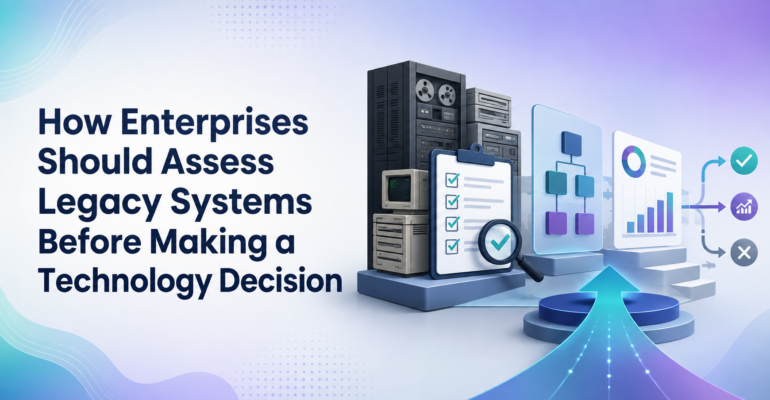
How Enterprises Should Assess Legacy Systems Before Making a Technology Decision
 Brainiuminfotech
 Replacing a legacy application is rarely as simple as replacing the technology underneath it. The system may support critical operations, exchange data with multiple business applications, contain years of embedded business logic, or underpin processes that were never formally documented. That makes the first question less about what technology should replace it and more about what the business could lose by changing it.
Should the system move to the cloud? Should it be rebuilt, replaced, or exposed through APIs? Should AI be added to it?
Those are second-stage questions. Before making any of them, enterprises need to understand the business capabilities, dependencies and constraints tied to the existing system. A sound legacy system modernization strategy starts with understanding what exists, and not deciding what should replace it.
Understand What the System Actually Does for the Business
The first mistake in assessing a legacy system is treating the application as the capability itself. The software is only the mechanism through which the business performs a particular function. What matters first is understanding that function, how deeply it is embedded in operations, and what the organisation would lose if it changed.
Consider an insurance application that appears to be responsible for processing policies. Its real business role may be considerably broader. Over years of use, it may have accumulated rules for eligibility, pricing, approvals and exceptions that determine how policies are handled. Some of those rules may exist only in the application and in the knowledge of the people who work with it.
This is why technical age is a poor measure of business importance. A twenty-year-old system can remain critical because of the capability it supports, while a newer application can become a constraint if it no longer serves the way the business operates.
The assessment therefore needs to establish the capability that sits behind the application before considering what should happen to the technology.
Map What the System Depends On and What Depends on It
A system rarely operates in isolation. Once its role in the business is clear, the next step is to trace the connections around it. This is where an application diagram can tell only part of the story.
Enterprise dependencies generally fall into three layers:
- Technical: The applications, databases, APIs, middleware, authentication services and third-party platforms the system connects to
- Data: The information it receives, transforms, stores or passes to other systems
- Operational: The processes people or other teams have built around the system to keep work moving
The third layer is particularly easy to miss. A legacy application might generate a file every morning, which an employee adjusts in a spreadsheet before another system can process it. That spreadsheet may never appear in the formal architecture, yet removing the file exchange could disrupt a critical workflow.
The same applies to scheduled jobs, manual approvals, reporting extracts and undocumented downstream processes. They form part of the system’s effective operating environment, whether or not they appear in an architecture diagram.
Mapping these relationships gives an enterprise a more realistic picture of what a change could affect.
Determine What Must Be Preserved Before Deciding What to Replace
Once the surrounding dependencies are visible, the next question is not yet what to modernize. It is what the business cannot afford to lose.
That requires separating the capability from the implementation that currently delivers it. A business capability is the outcome the organisation needs to keep achieving. The business rules determine how that outcome is produced; the underlying data supports it; interfaces provide access to it; and the technical implementation is simply the machinery holding those pieces together.
Those layers can evolve independently.
A database can be replaced without changing the process that relies on it. An integration can be redesigned while preserving the business rule behind the transaction. An ageing application can eventually be retired while the capability it provided is moved into a different architecture.
This distinction matters because some of the most difficult legacy systems are valuable precisely because they embody years of business knowledge. Replacing the application wholesale may discard useful behaviour along with obsolete technology.
The goal is not to preserve the legacy application but to preserve the business capabilities that still matter while creating room to change how they are delivered.
Identify the Constraints That Are Actually Driving Modernization
With the business capability and surrounding dependencies mapped, the next step is to identify what is actually making the current environment difficult to sustain or change. Calling all of it “technical debt” hides important differences.
| Constraint | What to look for |
| Technical | Unsupported platforms, obsolete runtimes, tightly coupled components or deployment processes that make changes risky |
| Data | Fragmented, duplicated or inaccessible data that prevents systems from using information consistently |
| Integration | Brittle point-to-point connections, batch-dependent communication or undocumented interfaces that make changes ripple across systems |
| Operational | Manual workarounds, difficult support processes or reliance on employees with knowledge that is difficult to replace |
| Business | Regulatory requirements, uptime expectations, changing scale or new customer demands that the existing environment struggles to accommodate |
These constraints can also overlap. A tightly coupled application may make an integration difficult to change, while fragmented data may force employees to maintain manual processes outside the system.
The important point is that identifying a constraint does not automatically justify replacing the application. The constraint tells you where the problem lies and how it affects the business. Deciding what to do about it comes later.
Assess What the Legacy Environment Needs to Support for AI
AI can change the requirements placed on a legacy environment. A system that works adequately for its existing users may become a constraint when the business wants new software to access its data, apply its rules or participate in its workflows.
Take a customer service application. An AI assistant might sit in front of it, but that does not mean the assistant suddenly has a reliable view of the customer. Relevant information may still be split between the application, a CRM, older databases and scheduled exports. Some decisions may also depend on rules buried inside the legacy application rather than exposed through a usable interface.
That makes the assessment more practical than asking whether a system is “AI-ready.” The real questions are whether the information AI-enabled software needs can be accessed reliably, whether existing rules can be used without bypassing them, whether permissions still hold, and whether the new capability can fit into the way work is actually carried out.
Adding AI to an existing application and preparing the environment to support AI are two different engineering problems.
Use the Assessment to Choose the Right Modernization Approach
The assessment should make one thing clear: how much of the existing system actually needs to change. That decision depends on where the current limitations sit.
Keep what still works
If the application continues to support the required capability and its limitations are manageable, retaining it may be more sensible than modernizing for its own sake.
Change the foundation
If the application remains useful but its infrastructure or platform is holding it back, rehosting or replatforming may address the problem without disturbing the application unnecessarily.
Change the architecture
If the way the application is structured is making it difficult to maintain, scale or extend, targeted refactoring may be appropriate.
Start again where necessary
A rebuild can make sense when the existing implementation is so restrictive that preserving it would create more work than replacing it.
Replace what no longer fits
If another system can provide the required capability more effectively, there may be little value in carrying the legacy application forward.
Take it in stages when risk demands it
For highly interconnected or operationally critical systems, incremental modernization can reduce the disruption of a large-scale change.
These choices can coexist across the same enterprise. A critical ERP component may need to evolve gradually, while an obsolete internal application could be replaced outright.
The important thing is that the modernization approach follows the assessment. It should not be selected first and then used to determine what the system is supposed to become.
In Conclusion,
The hardest modernization decisions are rarely about choosing between technologies. They are about knowing what can safely change without disrupting the business that has grown around the existing system.
That is why discovery needs to happen before architecture decisions are locked in. Once the existing environment is understood, enterprises can modernize where it creates the most value rather than replacing technology simply because it is old.
Brainium helps enterprises with their legacy system modernization using AI-assisted analysis to uncover application logic, dependencies and modernization opportunities, while keeping business continuity in view. From targeted modernization to larger transformation programmes, the goal is to make legacy systems easier to evolve and better prepared for AI-enabled software.
Planning a legacy modernization initiative? Talk to Brainium about assessing your existing application landscape and identifying where AI can help modernize it intelligently.