
How Dedicated Hiring Has Changed in the AI Era
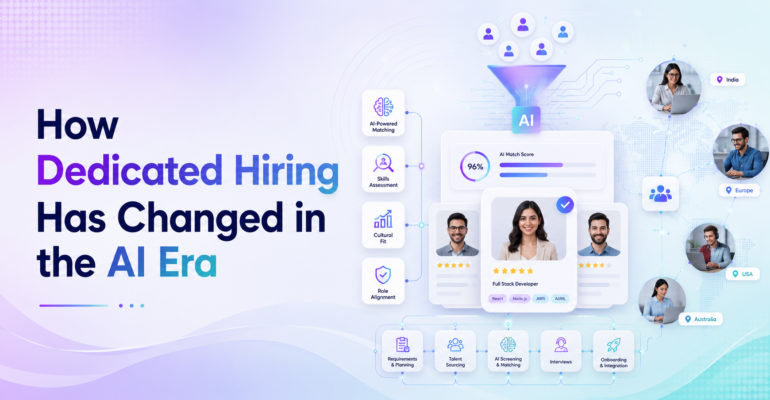
How Dedicated Hiring Has Changed in the AI Era
 Brainiuminfotech
 When AI coding assistants became mainstream, many assumed dedicated hiring would slow down. If AI could generate code, write tests, and accelerate development, why would businesses continue investing in dedicated developers?
Instead, the opposite has happened. Organizations are still building dedicated development teams, but they’re hiring for very different reasons than they did just a few years ago. The value of dedicated hiring has shifted from adding engineering capacity to gaining the expertise needed to deliver complex software in an AI-assisted world.
The reason is simple. AI has made writing code faster, but it hasn’t made software delivery simpler. Businesses still need to modernize legacy systems, integrate AI into existing products, maintain security and compliance, reduce technical debt, and ship reliable software at speed. Those challenges depend on engineering judgment, system architecture, and business context as much as code generation.
As a result, companies are rethinking what they expect from dedicated developers and the teams they hire. Technical skills still matter, but they’re no longer enough on their own. Success increasingly depends on developers who can combine AI-assisted workflows with problem-solving, ownership, and the ability to build software that delivers measurable business outcomes.
This article explores how dedicated hiring has evolved in the AI era, what’s driving this shift, and what businesses should evaluate when choosing a dedicated development partner today.
Dedicated Hiring is No Longer About Adding More Developers
Not too long ago, the conversation around dedicated hiring usually began with numbers. A product roadmap had expanded, delivery timelines were slipping, or an internal team didn’t have enough bandwidth. The solution was straightforward. Bring in more developers and get the project moving again.
That approach still has its place, but it’s no longer the question many businesses ask first.
Today, hiring discussions are increasingly centered on the problem that needs to be solved rather than the number of people required to solve it. A company planning to modernize a legacy platform isn’t simply looking for five experienced developers. It’s looking for a team that’s handled legacy modernization before. An organization introducing AI into an existing product wants engineers who understand how AI fits into production systems—not just how to build a prototype.
That’s a subtle change, but it fundamentally alters what dedicated hiring means. The conversation shifts from “How quickly can we scale the team?” to “Who has solved a challenge like ours?” Experience becomes part of the product being purchased instead of remainiung a line on a résumé.
| Traditional Dedicated Hiring | Dedicated Hiring Today |
| Expand development capacity | Access proven expertise for specific challenges |
| Fill open engineering roles | Solve modernization, integration, or scaling problems |
| Prioritize availability | Prioritize relevant experience |
| Measure contribution by output | Measure contribution by business impact |
This evolution happened because software projects became more interconnected, more difficult to modernize, and more critical to day-to-day operations. As those demands increased, dedicated hiring evolved from a staffing exercise into a way of bringing proven experience into the business exactly where it was needed.
Why Faster Coding Changed Hiring More Than Development Itself
So ,we already know how dedicated hiring has become less about expanding teams and more about bringing in proven expertise. That shift wasn’t driven by a sudden shortage of developers or by AI replacing them. It happened because AI changed where businesses derive value during software development.
For decades, writing software consumed a significant share of a project’s time and effort. Today, AI can accelerate many of those implementation tasks.
Code can be generated faster, documentation drafted in minutes, and repetitive development work completed with far less manual effort. But software projects don’t succeed because code is written quickly. They succeed because hundreds of technical decisions made before, during, and after development are the right ones.
That’s where the bottleneck has moved.
Once implementation became faster, businesses started paying closer attention to everything that surrounds it: architectural decisions, system integrations, security reviews, regulatory requirements, data migration, long-term maintenance, and the ability to evolve software without creating unnecessary technical debt. These weren’t new challenges. They were always there. AI simply made them more visible by reducing the time spent on one part of the engineering process.
| Before AI-assisted Development | Today |
| Much of the effort went into writing and implementing code | More attention is spent on architecture, integration, and long-term maintainability |
| Delivery speed depended largely on development capacity | Delivery success depends on making sound engineering decisions early |
| Hiring often focused on expanding delivery teams | Hiring increasingly focuses on solving specific engineering challenges |
| Technical expertise supported implementation | Technical expertise shapes planning, implementation, and future scalability |
This is why hiring conversations sound different today. Instead of asking whether a team can increase development capacity, businesses increasingly ask whether that team has solved similar challenges before. Experience with legacy modernization, cloud migration, AI integration, or enterprise-scale systems becomes valuable not because these are fashionable technologies, but because the cost of making the wrong engineering decision is far greater than the cost of writing the code itself.
How the Role of Dedicated Developers Has Evolved
The biggest change isn’t that developers use AI. Almost everyone does now. The difference lies in where experienced developers spend their attention.
A few years ago, much of a project’s effort went into implementation. Once the requirements were clear, success largely depended on writing reliable code and delivering it on time. AI has shortened that part of the process, but it hasn’t shortened the conversations that happen before a feature is approved or after it goes live.
That’s where experienced dedicated developers are spending more of their time.
It’s often in meetings where a seemingly simple feature turns out to affect three other systems. It’s reviewing AI-generated code that works on paper but doesn’t fit the architecture of the product. It’s recognizing that a “quick fix” solves today’s problem while creating another one six months from now. Those moments don’t usually appear in sprint reports, yet they’re often where the success or failure of a project is decided.
When businesses invest in dedicated developers today, they’re usually looking for people who can contribute beyond implementation. That often means developers who can:
- Explain the trade-offs behind different technical approaches instead of simply accepting the first workable solution
- Spot dependencies or integration issues before they become expensive to fix
- Use AI to speed up routine work while applying human judgment to the parts that affect reliability, security, and long-term maintainability
- Understand enough about the product and the business to recognise when a requirement solves the symptom rather than the underlying problem.
Writing code is still the foundation of the role. What’s changed is that code is no longer the only place where experienced developers create value. More often than not, it’s the decisions they help a business avoid that have the greatest impact over the life of a product.
How to Evaluate a Dedicated Development Team in the AI Era
Choosing a dedicated development team has become less about verifying technical skills and more about understanding how that team thinks. Most experienced partners can work with modern frameworks, cloud platforms, or AI tools. The bigger difference lies in how they approach unfamiliar problems, technical trade-offs, and the decisions that shape a project long before the first release.
If you’re evaluating a dedicated team today, these questions often reveal more than a list of technologies ever will.
I. What does the first technical conversation focus on?
If the discussion quickly moves to timelines, team size, or pricing, you’re still talking about staffing. Strong engineering partners usually spend that time understanding your existing systems, business constraints, and where the project is most likely to fail.
II. Where would they choose not to use AI?
Every development company can demonstrate AI-assisted workflows. Fewer can explain when human review, custom engineering, or manual testing is the better option. Knowing where not to automate is often a sign of technical maturity.
III. How do they respond when requirements change?
Software projects rarely follow the original plan. Look for teams that explain the trade-offs, suggest alternatives, and help you make informed decisions instead of simply implementing every new request.
IV. Can they point to similar engineering challenges they’ve solved?
Familiarity with a programming language isn’t the same as experience modernizing legacy systems, integrating AI into existing products, or scaling software that’s already in production. Context matters.
V. What happens after the software goes live?
Launch is rarely the finish line. Ask how they handle performance issues, evolving business needs, and the technical improvements that inevitably follow a successful release.
The strongest dedicated teams don’t distinguish themselves by promising to build everything faster. They stand out because they reduce uncertainty. They ask better questions, make better decisions, and help businesses avoid expensive mistakes before they happen. That’s increasingly what organizations are investing in when they choose a dedicated development partner.
Why Dedicated Hiring Is Becoming an Engineering Partnership
The real value of a dedicated development team rarely shows up in the first sprint. It becomes visible months later, when the team knows the product well enough to spot problems that aren’t written into a specification.
A developer joining a mature project can usually understand the codebase within a few weeks. Understanding why the codebase looks the way it does takes much longer.
- Why one integration was chosen over another
- Why a particular workflow exists because of a customer’s operational process
- Why an old module hasn’t been replaced yet because three other systems still depend on it
Those decisions are often scattered across conversations, design reviews, and years of product evolution.
That’s why many businesses are rethinking what they expect from dedicated hiring. They’re no longer looking for a team that can simply complete the next backlog. They’re looking for a team that builds enough product knowledge to make better decisions with every release.
You can often recognize that shift in long-running software projects. The most valuable dedicated teams don’t wait for requirements before adding value. They point out when a proposed feature conflicts with an existing workflow, remember why an earlier solution was abandoned, and identify technical debt before it slows down the next release.
Over time, they’re contributing far more than development effort. They’re contributing accumulated understanding.
That’s what turns a vendor relationship into an engineering partnership.
The difference isn’t just continuity. It’s the confidence that comes from working with a team that understands your product, your business constraints, and the reasoning behind past technical decisions. That kind of understanding can’t be handed over in a knowledge transfer document or recreated in a few onboarding sessions. It has to be built over time.
In Conclusion,
The biggest change in dedicated hiring isn’t that businesses need fewer developers or more AI. It’s that they’re placing a higher value on engineering decisions than ever before.
As software becomes faster to build, the real differentiator becomes the quality of the thinking behind it. That’s why dedicated hiring is steadily moving beyond a staffing model and becoming an engineering partnership built on experience, shared context, and the confidence to solve complex problems together.
For businesses evaluating their next technology partner, that’s the question worth asking: Will this team simply build what’s requested, or will they help us build the right thing?
At Brainium, we believe dedicated hiring should do exactly that. We work alongside businesses to solve complex engineering challenges, modernize existing systems, and build software that’s designed to deliver value long after launch.
Frequently Asked Questions
1. What is dedicated hiring?
Dedicated hiring is a software engagement model where a business works with developers or an engineering team that focuses exclusively on its projects. Unlike traditional outsourcing, dedicated teams become an extension of the in-house team, supporting ongoing development, collaboration, and long-term product goals.
2. Why are companies still hiring developers if AI can write code?
AI can generate code and automate repetitive development tasks, but it doesn’t replace architectural planning, system integration, security reviews, testing, or long-term product maintenance. Businesses continue hiring dedicated developers because successful software depends on engineering decisions, not just code generation.
3. Is dedicated hiring still relevant in the AI era?
Yes. AI has changed what businesses expect from dedicated teams rather than eliminating the need for them. Companies increasingly look for developers who can combine AI-assisted development with technical judgment, domain expertise, and experience solving complex engineering challenges.
4. What’s the difference between staff augmentation and dedicated hiring?
Staff augmentation adds developers to increase an existing team’s capacity. Dedicated hiring goes further by providing engineers who work closely with the business, contribute to technical decisions, and develop long-term knowledge of the product, making them an integrated part of the engineering team.
5. Can AI replace dedicated developers?
No. AI is a productivity tool, not a replacement for experienced engineers. Dedicated developers are still responsible for evaluating AI-generated code, making architectural decisions, solving integration challenges, and ensuring software remains secure, scalable, and maintainable.
6. When should a business choose a dedicated development team?
Dedicated hiring is often the right choice for long-term software products, legacy modernization, AI integration, cloud migration, platform scaling, or projects that require continuous development and close collaboration with an experienced engineering team.
7. Is dedicated hiring better than project-based outsourcing?
It depends on the project. Dedicated hiring is generally better for products that evolve over time because the team builds technical and business knowledge as the project grows. Project-based outsourcing is often more suitable for short-term initiatives with clearly defined requirements and timelines.
8. Does AI reduce the cost of dedicated hiring?
AI can reduce the time spent on coding, documentation, and testing, but the biggest cost savings often come from avoiding expensive engineering mistakes. Experienced dedicated teams use AI to improve productivity while applying human judgment to decisions that affect the software’s long-term success.