How CogniBase Turns PDFs, Reports, and Business Documents into Instant AI Answers
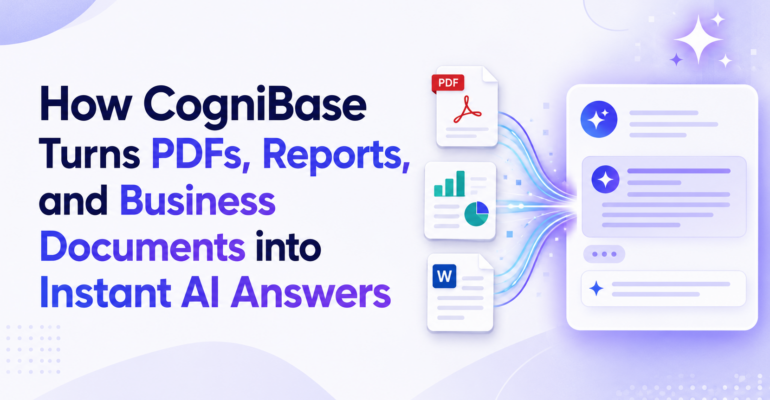
How CogniBase Turns PDFs, Reports, and Business Documents into Instant AI Answers
 Brainiuminfotech
 Quick Answer
CogniBase is an AI-powered document intelligence platform that helps businesses, teams, and professionals turn static documents into instantly searchable knowledge.
Instead of manually scanning PDFs, reports, spreadsheets, presentations, and business files, users can ask questions in plain English and receive context-aware answers pulled directly from uploaded documents.
Rather than functioning like a traditional file storage system, CogniBase acts more like an intelligent knowledge assistant. It understands document context, connects information across multiple files, and allows users to retrieve insights conversationally.
In practical terms, this helps organizations:
- Reduce time spent searching for information,
- Improve operational efficiency,
- Preserve institutional knowledge,
- Accelerate research and decision-making,
- Make large document collections easier to use.
As businesses continue generating massive volumes of information every day, AI-powered document search is quickly becoming more important than traditional keyword-based file management systems alone.
Why Are Businesses Struggling to Find Information Inside Their Own Documents?
Most organizations already have access to enormous amounts of information.
The problem is that the information is often trapped inside disconnected files, folders, reports, presentations, contracts, and internal documentation systems.
On paper, businesses appear highly organized. Documents are stored in cloud drives, categorized into folders, and archived properly. Yet operationally, teams still spend surprising amounts of time trying to locate information they know already exists somewhere.
That inefficiency becomes more visible as businesses scale.
A manager preparing for a client meeting may need to review months of project reports, emails, proposals, and presentations. Legal teams may spend hours locating specific clauses buried across vendor agreements. New employees often struggle to understand historical context because important knowledge exists only inside scattered documentation.
Traditional document systems were never designed to solve this problem completely.
Most document management tools primarily focus on storage and retrieval. They help users locate files through folder structures, tags, or keyword searches. But locating a file is not the same as understanding the information inside it quickly.
That distinction matters.
Modern businesses are no longer dealing with a shortage of information. They are dealing with information overload.
The challenge today is not storing documents. It is retrieving meaningful knowledge from those documents efficiently.
This is exactly where AI-powered document intelligence platforms like CogniBase become valuable.
What is an AI Document Assistant?
An AI document assistant is a platform that understands uploaded documents and allows users to retrieve information using natural language questions instead of manual keyword searches.
Rather than opening files one by one, users can simply ask direct questions such as:
- “What risks were mentioned in the Q3 project reports?”
- “Who is handling the Save Lah project?”
- “Summarize the key findings from the market research documents.”
- “What solutions were recommended for retail clients?”
The system analyzes uploaded documents, identifies relevant information, understands contextual relationships across files, and generates a direct response.
This changes how people interact with organizational knowledge.
Instead of searching for documents manually, users interact with information conversationally.
That shift is becoming increasingly important because knowledge workers today spend large amounts of time navigating fragmented information systems instead of using insights productively.
AI-powered document search helps reduce that friction by transforming static documentation into a searchable knowledge ecosystem.
How Does AI Improve Document Search and Knowledge Retrieval?
Traditional document search relies heavily on exact keywords, folder structures, and file names.
That approach works reasonably well when document collections are small. But as businesses accumulate years of reports, presentations, contracts, spreadsheets, and operational records, finding useful information becomes much harder.
AI-powered document retrieval works differently.
Instead of simply matching keywords, AI systems attempt to understand context, relationships, and intent behind a user’s question.
For example, a traditional search system might return dozens of files containing the phrase “budget planning.”
An AI-powered document assistant can instead answer questions like:
- “What budget concerns were raised most frequently last quarter?”
- “Which projects exceeded estimated budgets?”
- “What recommendations were made to reduce operational costs?”
This creates a much more efficient information retrieval experience because users receive insights instead of just file lists.
More importantly, conversational document search allows organizations to use information more actively rather than treating documents as passive archives.
How CogniBase Works
CogniBase is designed to make document interaction feel intuitive and conversational instead of technical.
From the user’s perspective, the workflow is simple. But underneath that simplicity, the platform processes and organizes document intelligence in a way that makes information retrieval significantly faster.
Step 1: Upload Your Documents
Users can upload multiple file formats, including:
- PDFs
- Word documents
- PowerPoint presentations
- Spreadsheets
- Text-based file
This allows businesses to centralize information from different sources into a single searchable knowledge environment.
Instead of depending entirely on manual folder structures, documents become part of an AI-powered knowledge base.
Step 2: Ask Questions Naturally
Once documents are uploaded, users can ask questions conversationally using plain English.
There is no need to remember exact filenames, tags, or storage locations.
For example:
- “What risks were identified in the acquisition reports?”
- “What product features did customers request most frequently?”
- “What themes appear across these research papers?”
The experience feels less like searching files and more like interacting with a knowledgeable assistant that understands the organization’s documents.
Step 3: Receive Context-Aware Answers
CogniBase does not simply return matching files. Instead, it generates direct responses using information identified across uploaded documents while also referencing the relevant source materials.
That distinction is important because users often need both the answer and the supporting context behind it.
This approach helps teams retrieve meaningful insights faster without manually scanning dozens of files individually.
Step 4: Continue the Conversation
Information retrieval rarely stops with a single question.
Users often need summaries, comparisons, follow-up clarification, or deeper analysis.
CogniBase supports conversational continuity by allowing users to continue interacting naturally with uploaded knowledge.
For example: “What risks were mentioned in the vendor agreements?”
Follow-up: “Which risks appeared most frequently?”
Additional follow-up: “Summarize the mitigation strategies recommended.”
This creates a far more fluid knowledge discovery experience than traditional search systems.
Why are Businesses Adopting AI-Powered Knowledge Systems?
Businesses today generate enormous amounts of operational information every year.
The problem is that most organizations still rely on systems originally designed only for document storage, not intelligent knowledge retrieval.
As documentation grows, several operational problems start appearing repeatedly.
| Operational Challenge | Business Impact |
| Employees spend time searching manually | Reduced productivity |
| Important insights remain buried in files | Slower decision-making |
| Teams rely heavily on tribal knowledge | Information silos |
| New employees struggle with historical context | Longer onboarding cycles |
| Knowledge leaves when employees leave | Institutional memory loss |
| Repetitive questions across departments | Operational inefficiency |
AI-powered knowledge systems help solve these problems by making information easier to access conversationally. Instead of depending entirely on human memory, teams can retrieve organizational knowledge directly from documents whenever they need it.
That shift becomes increasingly valuable as businesses scale and information complexity increases.
Who Can Use CogniBase for AI Document Search?
One reason AI document intelligence platforms are becoming increasingly valuable is because document overload affects almost every department differently.
CogniBase supports a wide range of business and knowledge-management workflows.
How Can Business Teams Use AI Document Search?
Business teams often manage large collections of reports, project documentation, presentations, budgets, and internal updates.
Finding insights manually across those files can consume significant operational time.
With CogniBase, teams can retrieve answers conversationally instead of reviewing documents individually.
For example:
- “Show me all risks mentioned in the Q3 reports.”
- “What customer complaints appeared most frequently?”
- “Summarize the key findings from the market analysis.”
This allows teams to move faster while maintaining better operational visibility.
How Can Researchers Use AI Document Intelligence?
Researchers and students frequently work across large volumes of academic papers, reference materials, and research documents. Reviewing those materials manually is time-consuming, especially during literature reviews or thematic analysis.
CogniBase helps researchers identify recurring themes, summarize methodologies, and retrieve relevant information conversationally.
Instead of repeatedly scanning documents manually, users can interact with their research collections more efficiently through natural language search.
How Does AI Help Legal Teams Review Documents Faster?
Legal and compliance teams often deal with dense, detail-heavy documentation.
Contracts, vendor agreements, compliance policies, and due diligence files require careful review, but manually scanning large document collections consumes substantial time.
CogniBase helps legal teams retrieve relevant clauses and identify important references faster.
For example:
- “What termination clauses appear in vendor agreements?”
- “Show all references to data privacy requirements.”
- “What risks were identified in acquisition documents?”
This improves document accessibility while reducing repetitive review effort.
How Can Consultants Use AI to Analyze Business Documents?
Consultants and analysts regularly work across strategy reports, client documentation, market analysis files, and operational records.
That creates information fragmentation quickly.
CogniBase allows consultants to retrieve comparative insights across multiple documents without manually reviewing files individually.
This can accelerate:
- Client preparation
- Strategic analysis
- Research synthesis
- Recommendation development
Real-World AI Document Search Use Cases
New Employee Onboarding
New employees often struggle to understand company history, project context, and operational processes because critical knowledge exists inside archived documentation.
With CogniBase, employees can ask questions conversationally instead of depending entirely on colleagues for information.
For example:
- “What campaigns performed best last quarter?”
- “What operational challenges were identified previously?”
- “Summarize our current client priorities.”
This helps employees become productive faster while reducing dependency on tribal knowledge.
Client Meeting Preparation
Preparing for major client meetings often requires reviewing multiple reports, proposals, emails, and presentation decks.
That process can be time-consuming and inconsistent.
Using CogniBase, teams can quickly retrieve historical context, previous recommendations, and documented client concerns through conversational search.
For example:
- “What solutions have we proposed to Microsoft previously?”
- “What concerns were raised during earlier discussions?”
- “What outcomes were documented in previous strategy meetings?”
This creates faster preparation workflows while improving contextual understanding.
What is the Difference Between AI Document Search and Traditional File Search?
Traditional file search systems were designed primarily for storage and retrieval. AI-powered document intelligence platforms are designed for contextual understanding and conversational access to information.
That difference changes how teams interact with organizational knowledge.
| Area | Traditional File Search | CogniBase AI Document Intelligence |
| Search Method | Keyword-based | Conversational natural language |
| Information Retrieval | Returns matching files | Generates contextual answers |
| Cross-Document Understanding | Limited | Connects insights across documents |
| User Experience | Manual navigation | Conversational interaction |
| Knowledge Accessibility | File-dependent | Insight-driven |
As document complexity continues increasing, businesses increasingly need systems that help teams retrieve actionable insights instead of simply locating files.
Why Businesses Need AI-Powered Knowledge Retrieval Systems
The volume of business documentation continues growing every year.
At the same time, organizations are under increasing pressure to:
- Make faster decisions
- Improve efficiency
- Preserve institutional knowledge
- Reduce repetitive operational work
- Improve collaboration across teams
Traditional document systems alone are no longer sufficient for those requirements. Businesses increasingly need intelligent knowledge retrieval systems capable of helping teams access information instantly without navigating endless folders or manually scanning reports.
This is why AI-powered document intelligence is becoming an important part of modern operational infrastructure.
The shift is not only about automation. It is about making organizational knowledge more usable.
In Conclusion,
Most organizations already possess valuable knowledge inside their documents.
The problem is that retrieving that knowledge efficiently remains difficult.
CogniBase helps solve that challenge by transforming static files into an AI-powered knowledge ecosystem where users can ask questions naturally, retrieve contextual answers instantly, and explore information conversationally.
As businesses continue generating larger volumes of operational data and documentation, AI-powered document intelligence platforms will likely become increasingly important for improving efficiency, collaboration, and decision-making.
Want to see how AI-powered document intelligence can improve the way your team works with information?
Explore CogniBase to learn how businesses can turn PDFs, reports, research files, and operational documents into instantly searchable knowledge through conversational AI.Visit our website to request a demo today.
Frequently Asked Questions
1. What is CogniBase?
CogniBase is an AI-powered document intelligence platform that helps users retrieve information from PDFs, reports, presentations, spreadsheets, and business documents using natural language questions. Instead of manually searching through folders or files, users can ask conversational questions and receive context-aware answers generated from uploaded content. This helps businesses improve productivity, reduce information retrieval time, and make organizational knowledge more accessible across teams.
2. How does AI document search work?
AI document search works by analyzing document content contextually instead of relying only on exact keywords or file names. Users can ask questions conversationally, and the system identifies relevant information across uploaded documents to generate direct answers. This makes knowledge retrieval significantly faster and more efficient for organizations managing large volumes of operational documentation.
3. Can AI answer questions from PDFs and business documents?
Yes. AI-powered document intelligence systems like CogniBase can analyze PDFs, reports, contracts, spreadsheets, presentations, and other business documents to answer questions based on uploaded content. Instead of manually reviewing files one by one, users can retrieve summaries, insights, references, and contextual information instantly through conversational search.
4. What file formats does CogniBase support?
CogniBase supports multiple business document formats, including PDFs, Word documents, PowerPoint presentations, spreadsheets, and text-based files. This allows organizations to centralize information from different sources into a single AI-powered knowledge environment. Supporting multiple formats also makes it easier for teams to search across operational, research, legal, and analytical documents together.
5. Can CogniBase analyze multiple documents together?
Yes. CogniBase can connect information across multiple uploaded documents to generate more comprehensive and context-aware answers. Instead of treating each file separately, the platform identifies relationships, recurring themes, and supporting references across documents. This is especially valuable for research analysis, business reporting, compliance reviews, and strategic decision-making.
6. How does conversational document search improve productivity?
Conversational document search reduces the time employees spend manually searching through folders, reports, and archived files. Instead of navigating complex storage systems, users can retrieve information instantly by asking questions naturally. This improves operational efficiency, accelerates decision-making, and helps teams access organizational knowledge much faster.
7. Who can benefit from AI-powered document intelligence?
Business teams, consultants, researchers, legal professionals, analysts, HR departments, executives, and compliance teams can all benefit from AI-powered document intelligence. Any organization managing large volumes of information can use conversational document search to improve knowledge accessibility, reduce repetitive manual work, and retrieve insights more efficiently.
8. Can AI summarize reports, contracts, and research files?
Yes. AI-powered document intelligence platforms like CogniBase can summarize reports, contracts, research papers, and operational documents by identifying key themes, important insights, and recurring patterns within uploaded files. This helps users review large volumes of information faster without manually reading every document individually.
9. Does CogniBase replace document storage systems?
No. CogniBase does not replace existing document storage platforms. Instead, it works as an intelligent layer on top of existing document systems by improving how users search, retrieve, and interact with stored information. The goal is to make organizational knowledge more accessible and usable rather than replacing file storage infrastructure entirely.
10. Why are businesses adopting AI-powered knowledge management systems?
Businesses are adopting AI-powered knowledge management systems because traditional document search methods become inefficient as information volumes grow. AI-driven platforms help organizations reduce information overload, preserve institutional knowledge, improve collaboration, and retrieve operational insights faster. This allows teams to work more efficiently while making better use of existing business information.
11. How can businesses get started with CogniBase?
Businesses interested in using CogniBase can explore the platform through Brainium and request a personalized demo based on their document management and knowledge retrieval requirements. This allows teams to understand how AI-powered document search can fit into their existing workflows, operational systems, and business processes. Organizations can also evaluate how CogniBase supports collaboration, research, analytics, and enterprise knowledge management across different use cases.