Can AI Actually Replace Company Knowledge?
Can AI Actually Replace Company Knowledge?
 Brainiuminfotech
 Businesses have never documented more than they do today. Every meeting is recorded, every process is written down, and every project leaves behind a trail of documents, reports, and messages.
Yet ask a simple question like “What did we agree with this client last quarter?” or “Which version of the policy is current?” and finding the answer often takes longer than it should.
That’s what makes the rise of AI so compelling. If AI can instantly answer questions, could it eventually replace the need for company knowledge altogether?
It’s an understandable assumption, but it misunderstands what company knowledge actually is.
Company Knowledge is More than a Collection of Documents
Open any shared drive and you’ll probably find thousands of documents, including contracts, project plans, meeting notes, proposals, SOPs, and reports. On paper, it looks like the business has documented everything.
But ask someone why a long-standing client was given an exception to the pricing policy, or why a process changed two years ago, and the answer often isn’t in a document. It’s in someone’s memory, buried in an email thread, or spread across half a dozen conversations that happened over months.
That’s the difference between information and company knowledge.
Information tells you what exists. Company knowledge explains how it came to be, what happened next, and whether it still holds true today.
The distinction matters because businesses rarely lose knowledge overnight. It happens gradually. People leave, projects end, decisions become harder to trace, and the story behind the documents starts to disappear.
So before asking whether AI can replace company knowledge, it’s worth asking something simpler: is company knowledge really the same thing as the documents we’ve been storing all along?
Can AI Replace Experience as Well as Information?
If company knowledge were nothing more than stored information, the answer would probably be yes. Feed enough documents into an AI system, and it can retrieve, summarise, and explain what’s written.
But businesses don’t really run on information alone.
They run on accumulated experience.
Think about the person everyone turns to before making an important decision. It’s rarely because they’ve memorised every policy or project document. It’s because they know which policy matters in this situation, which client expectation isn’t written down, or why a process changed after something went wrong three years ago. Experience compresses years of decisions into judgment.
That’s where the line between information and knowledge becomes clearer.
Information can be documented. Experience has to be accumulated. AI can certainly learn from documented experience if it’s available, but it doesn’t create that experience on its own. It can’t know why a team stopped following a process unless that reasoning exists somewhere for it to discover.
Perhaps that’s the wrong way to think about AI in the first place.
The goal isn’t to replace the people or the experience that built your company’s knowledge. It’s to make more of that experience accessible, so it isn’t locked inside a handful of individuals or lost every time someone leaves the business.
Why Good Answers Still Depend on Good Knowledge
One reason AI feels so convincing is that it hides most of the work behind an answer.
When someone asks a colleague a question, they can usually tell whether the response comes from firsthand experience, a policy document, or an educated guess. AI removes those signals. It simply returns an answer, often in the same clear, confident tone regardless of where the information came from.
That changes the way we judge the response. We stop asking, “Where did this come from?” and start asking, “Does this sound right?”
For everyday questions, that may not matter much. Inside a business, it matters a great deal. A customer commitment, a compliance requirement, or a technical specification isn’t valuable because it sounds plausible. It’s valuable because it can be traced back to something the business knows to be true.
That’s why good answers don’t begin with AI. They begin with good knowledge. AI can bring together information, explain it, and present it in a way that’s easier to understand, but it still needs something dependable to work from.
The real question, then, isn’t whether AI can answer questions. It’s whether your business has knowledge that’s consistent, current, and connected enough for those answers to be trusted.
Preparing Company Knowledge for the AI Era
For a long time, imperfect knowledge wasn’t always a problem.
If a policy was out of date, someone usually knew. If a customer exception wasn’t documented, the account manager remembered. Teams found ways to work around gaps because experience filled them in.
AI changes that dynamic.
The moment a business expects AI to answer internal questions, every inconsistency becomes easier to spot. An outdated process isn’t just an old document anymore. It becomes a potential answer. A forgotten exception isn’t just hidden in someone’s inbox. It becomes invisible to everyone else.
In that sense, preparing for AI has surprisingly little to do with the AI itself. It starts with taking ownership of the knowledge the business depends on every day.
That means asking questions like:
- Which information do we trust?
- What has changed but never been updated?
- Where does important knowledge still depend on one person’s memory?
- If two employees asked the same question today, would they get the same answer?
Those aren’t AI questions. They’re business questions.
AI simply makes them impossible to ignore.
Knowledge Creates Value Only When It’s Usable
Businesses often assume that once something has been documented, the job is done. In reality, documentation is only the starting point.
A process that’s never consulted, a lesson buried in an old project report, or a customer decision hidden in an email thread adds very little value, even if it technically exists. Knowledge becomes valuable the moment it helps someone make a better decision.
That’s the shift AI is quietly accelerating. It’s encouraging businesses to think less about where knowledge is stored and more about whether it can be used when someone needs it.
The organisations that benefit most won’t necessarily be the ones with the largest knowledge base. They’ll be the ones that make years of accumulated experience available in a way that’s easy to understand, verify, and apply.
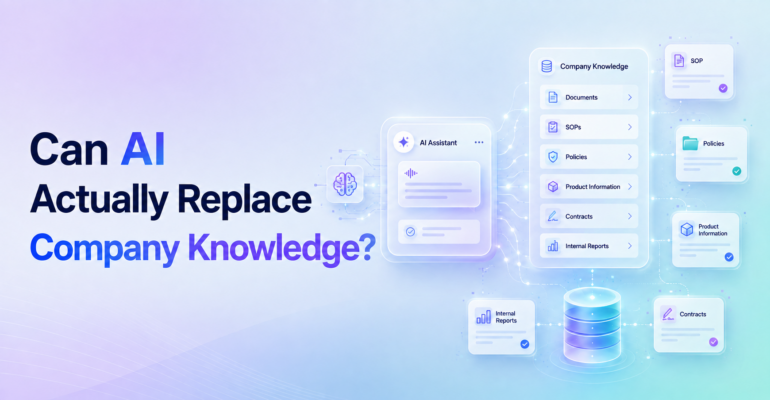
This is where enterprise knowledge platforms such as CogniBase fit into the picture. Rather than creating another place to store information, they help teams interact with the knowledge already embedded across reports, manuals, presentations, contracts, and other business documents through natural language, making existing knowledge easier to use instead of simply easier to archive.
The Next Competitive Advantage Is Knowledge Infrastructure
For years, businesses have invested in the infrastructure that keeps operations running, from finance systems and CRMs to cloud platforms and cybersecurity. AI is exposing another layer that has often been overlooked: the infrastructure behind company knowledge.
Not the documents themselves, but the systems and processes that keep knowledge accurate, connected, and available long after the people who created it have moved on.
The businesses that benefit most from AI won’t necessarily have more knowledge than everyone else. Most organisations already have years of reports, proposals, contracts, project documents, and operational know-how. The difference is whether that knowledge can actually be used.
Increasingly, that comes down to four questions:
- Can people trust the answer?
- Can they trace it back to its source?
- Can it reflect the latest decisions, not last year’s version?
- Can knowledge stay with the business instead of leaving with individuals?
That’s what knowledge infrastructure is really solving.
Platforms such as CogniBase reflect this shift. Rather than creating another place to store information, they help businesses interact with the knowledge already embedded across reports, manuals, presentations, contracts, and other business documents through natural language, turning years of accumulated knowledge into something people can actually use.
In Conclusion,
Perhaps the real question was never whether AI could replace company knowledge. It was whether businesses were making the most of the knowledge they already had.
As AI becomes part of everyday work, the organisations that see the greatest value won’t simply be the ones using the latest models. They’ll be the ones that have made their knowledge accurate, accessible, and ready to support better decisions.
That’s the idea behind CogniBase. It helps businesses turn years of accumulated knowledge into something employees can search, understand, and apply through natural conversation.
Ready to make your company’s knowledge work smarter? Explore CogniBase and discover how Brainium can help you build an AI-ready knowledge foundation.
Frequently Asked Questions
1. Can AI replace human knowledge?
No. AI can analyse, summarise, and retrieve information, but it cannot replace the experience, judgement, and context that people develop over time. In a business, company knowledge includes past decisions, customer relationships, and institutional memory that AI can only access if it has been documented and maintained.
2. What is company knowledge?
Company knowledge is the collective understanding a business builds through its people, processes, decisions, and experience. It includes documented information such as policies and reports, as well as the context behind them—why decisions were made, how processes evolved, and what lessons have been learned over time.
3. Why do AI tools give incorrect answers inside businesses?
AI often produces inaccurate or incomplete answers when it relies on outdated, inconsistent, or missing business information. If company knowledge is fragmented across documents, emails, or individual employees, AI has an incomplete picture. Improving the quality and accessibility of business knowledge usually has a greater impact than simply using a more advanced AI model.
4. Can AI answer questions from company documents?
Yes, provided it has secure access to relevant business documents and those documents are accurate and up to date. AI can retrieve information from reports, manuals, contracts, policies, and other internal files, but the quality of its answers depends on the quality of the knowledge it can access.
5. How can businesses prepare their knowledge for AI?
Preparing company knowledge for AI starts with organising and maintaining trusted information. Businesses should review outdated documents, capture important institutional knowledge, reduce duplicate or conflicting information, and ensure employees can access current, verified content. A strong knowledge foundation allows AI to deliver more reliable and useful answers.
6. What is the difference between a knowledge base and company knowledge?
A knowledge base is a repository where information is stored. Company knowledge is broader. It includes not only documents and records but also the context, experience, and decisions that help employees understand how that information should be applied. A business can have a large knowledge base while still struggling to preserve its company knowledge.