
Why Are AI Assistants Getting Smarter Even When the AI Model Isn’t?
Why Are AI Assistants Getting Smarter Even When the AI Model Isn’t?
 Brainiuminfotech
 In 2025 and 2026, some of the world’s largest technology companies stopped treating AI agents as eIf you’ve been using AI assistants regularly, you’ve probably noticed something interesting over the past year. They haven’t just become better at answering questions. They’ve become better at working with you.
They remember preferences, understand ongoing projects, pull information from multiple sources, use external tools, and often complete tasks that once required several back-and-forth prompts. For businesses planning their next AI initiative, or looking to hire developers in India, those improvements are changing expectations of what an AI assistant should actually be able to do.
That raises an interesting question. If the underlying AI models aren’t improving at the same pace they once were, why do AI assistants seem to be getting smarter every few months?
The answer is that we’re looking in the wrong place. For years, the industry measured progress by the capability of the language model alone. Today, much of the innovation happens around the model instead. Recent product releases across the industry increasingly emphasize memory, connectors, agent capabilities, enterprise integrations, and workflow execution rather than benchmark improvements alone.
In other words, the biggest advances in AI are no longer coming from a single model becoming dramatically more intelligent. They’re coming from building smarter AI systems around that model.
In short, AI assistants are becoming more capable because intelligence is no longer defined by the language model alone. Persistent memory, richer context, external tools, orchestration, and workflow execution increasingly determine how useful an assistant is, shifting the industry’s focus from building bigger models to building better AI systems.
Why Better AI Models Don’t Always Create Better AI Assistants
Whenever a new language model is released, the conversation usually follows a familiar pattern. People compare benchmark scores, reasoning ability, coding performance, context windows, and which model now sits at the top of the leaderboard. Those comparisons are valuable as they tell us how capable a foundation model has become. But they don’t fully explain why using AI today feels so different from even a year ago.
That’s because most of us don’t actually interact with language models. We interact with AI assistants.
It might sound like a small distinction, but it changes how we think about AI progress. A language model can generate an answer from the information it’s given. An AI assistant has to do much more than answer. It needs to decide what information is missing, where to find it, whether a tool should be used, and how to turn a user’s request into a completed task. In many cases, generating text is only one step in a much larger process.
That’s why judging an assistant solely by the model underneath it no longer tells the whole story. Two assistants running on the same foundation model can deliver completely different experiences depending on everything that surrounds it.
Consider a common workplace scenario. Ask a standalone language model to prepare you for a client meeting, and it can generate a well-structured agenda based on your prompt. Ask a modern AI assistant the same question, and it may review previous conversations, summarize CRM records, pull relevant documents, identify pending action items, and draft follow-up emails before the meeting even begins. The underlying model could be exactly the same in both cases, but what changes is everything built around it.
That distinction is becoming increasingly important because it’s where much of today’s innovation is happening. Rather than relying solely on more capable language models, organizations are designing smarter AI systems that combine models with memory, context, orchestration, tools, and workflow execution. Understanding those layers is the key to understanding why AI assistants continue to improve, even when advances in the underlying model appear far more gradual.
Why Businesses Needed More Than Prompt-Based AI
By now, it is becoming clear that building a better language model wasn’t enough. Once AI started moving from experiments into everyday business operations, a different set of challenges emerged that larger models alone couldn’t solve.
Think back to how generative AI was first used in the workplace. Most requests were self-contained, such as –
- Summarize this report
- Draft an email
- Explain a technical concept
- Write a SQL query
The interaction began with a prompt, ended with an answer, and then everyone moved on. But real work rarely follows that pattern.
Take something as routine as preparing for a client meeting. The task isn’t just about creating an agenda. Someone has to review previous conversations, check the latest CRM updates, skim recent documents, identify unresolved action items, and decide what deserves attention before walking into the room. The same is true for debugging software, responding to customer issues, or researching a new market. Generating text helps, but it’s only one piece of a much larger process.
That mismatch quickly became obvious as businesses tried to integrate AI into everyday workflows. A language model could produce impressive responses, yet it had no awareness of the company’s documents, couldn’t access business systems, didn’t remember ongoing projects, and had no reliable way to verify whether the information it generated was current or even correct.
The gap in context became too obvious to ignore.
| Business Task | Prompt-Based AI | Modern AI Assistant |
| Prepare for a client meeting | Generates an agenda from the prompt | Reviews meeting history, CRM records, documents, and action items before preparing a briefing |
| Investigate a software issue | Suggests likely causes | Analyzes logs, searches documentation, runs code where appropriate, and summarizes findings |
| Answer an internal policy question | Responds using the prompt alone | Retrieves the latest approved policy, verifies the answer, and cites the relevant source |
| Support a marketing campaign | Generates campaign ideas | Analyzes previous performance, gathers relevant data, drafts content, and supports execution across connected tools |
This is why AI assistants have evolved so quickly over the past two years. Businesses weren’t looking for a chatbot that could write better sentences. They needed software that could participate in real work. That meant remembering information between conversations, accessing knowledge beyond the prompt, coordinating with other applications, and helping users move a task forward instead of simply producing another response.
Each of those capabilities solves a different problem. Together, they explain why two assistants built on the same language model can feel remarkably different in practice and why many of the most noticeable advances in AI are increasingly happening around the model rather than inside it.
What Actually Makes AI Assistants Feel Smarter?
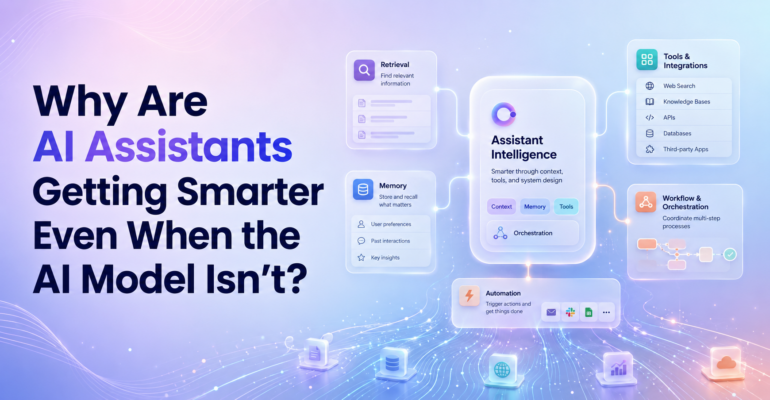
The biggest change in AI assistants isn’t that language models suddenly became far more intelligent. It’s that intelligence is no longer coming from one place.
Earlier AI systems depended almost entirely on the model itself. A prompt went in, the model generated a response, and the interaction ended there. Modern assistants still rely on language models, but the response you see is often the final step in a much larger process. Before answering, the assistant may gather information, recall previous interactions, decide whether external tools are needed, verify intermediate results, and then combine everything into a single response.
That’s why two assistants built on the same foundation model can feel completely different to use. Much of what users experience as “smarter AI” now comes from the system around the model rather than the model alone.
Context Makes AI More Relevant
Earlier assistants could only work with the information users provided. Today’s assistants often retrieve company documents, project files, customer records, or live business data before responding. That extra context means the answer is based on what’s actually relevant to the task.
Memory Creates Continuity
One reason modern assistants feel less repetitive is that they don’t always start from zero. Persistent memory allows them to remember preferences, continue ongoing work, and maintain continuity across conversations. Instead of repeatedly rebuilding context, users can simply continue where they left off.
Connected Tools Enable Action
The most noticeable shift is that assistants increasingly interact with the software people already use. They can search a CRM, check a calendar, browse internal knowledge, execute code, or trigger actions through connected business applications. The goal is no longer to produce the best possible answer but to help move the work itself forward.
Orchestration Brings Everything Together
Most interactions appear simple on the surface, but they’re often the result of several decisions happening in the background. An assistant may retrieve information from different sources, choose the appropriate tools, verify results, and decide how to combine everything before generating a response. Users see a single conversation. The assistant is often coordinating an entire workflow.
Trust Makes AI Useful at Scale
Technical capability alone doesn’t determine whether AI succeeds inside an organization. Businesses also need confidence that assistants respect permissions, follow governance policies, cite reliable information where appropriate, and keep humans involved in high-impact decisions. Trust isn’t a separate feature layered on afterward. It’s one of the reasons modern AI assistants like ChatGPT, Claude, Gemini, Microsoft Copilot, or enterprise assistants built in-house can be used for real work instead of isolated experiments.
The important point is that none of these capabilities replaces the language model. They extend it. Context contributes information, memory provides continuity, tools enable action, orchestration coordinates the process, and trust makes the entire system dependable. Together, they create a form of distributed intelligence where the assistant’s capability comes from how well all of these components work together.
Reality Check:
There’s no universal blueprint for building an AI assistant. The right combination of memory, retrieval, tools, and governance depends on the problem being solved. An internal knowledge assistant, a customer support copilot, and an autonomous coding agent may all use the same foundation model, yet require very different system designs to perform effectively.
Why AI Success Depends on More Than Model Selection
By this point, the discussion has shifted from how AI assistants are getting smarter to how businesses should evaluate them. That’s an important distinction because many AI adoption decisions are still driven by the language model at the center of the system.
It’s understandable why. Models are easy to compare. They have benchmark scores, context windows, reasoning evaluations, and release announcements that make headlines. But once AI becomes part of day-to-day operations, those comparisons only tell part of the story.
Two organizations can deploy the same foundation model and achieve completely different outcomes. One builds an assistant that employees rely on every day. The other ends up with another chatbot that struggles to move beyond a pilot. More often than not, the difference isn’t the model but how the assistant has been designed around it.
| Instead of asking… | Ask instead… |
| Which model has the highest benchmark score? | Which assistant consistently helps people complete real workflows? |
| Which model is the newest? | Does the assistant fit naturally into the way our teams already work? |
| Which model has the largest context window? | Can it reliably retrieve and use the right business information? |
| Which model generates the best responses? | Can it connect to our tools, automate tasks, and support execution? |
| Which model is “smarter”? | Can the overall AI system be trusted, monitored, governed, and improved over time? |
Looking at AI through this lens changes the conversation. Deploying an AI assistant is no longer just about selecting a model but more about designing an operational system. The model is one layer, but so are the knowledge sources it can access, the memory it maintains, the business applications it connects to, the workflows it supports, and the governance that keeps everything reliable.
Those decisions are increasingly what determine whether AI delivers measurable business value. A strong language model remains essential, but long-term success depends just as much on the system built around it. That’s where organizations are now creating meaningful differentiation, and where the next wave of AI advantage is likely to come from.
In Conclusion,
AI assistants are becoming smarter, but not for the reason many people assume. While language models continue to improve, they are no longer the sole measure of an assistant’s capability. Today’s AI systems combine models with context, memory, connected tools, orchestration, and governance to solve problems that extend well beyond generating text.
That shift changes how AI should be evaluated. The question is no longer which model tops the latest benchmark, but how effectively the entire system supports real work. Organizations that see the greatest value from AI won’t necessarily be the ones using the newest model. They’ll be the ones building assistants that fit naturally into their workflows, adapt to their business context, and help people make better decisions every day.
If your organization is planning to build AI assistants that go beyond prompt-based interactions, the focus should be on designing the right system. At Brainium, our AI engineers build assistants with enterprise integrations, workflow automation, memory, orchestration, and governance tailored to real business needs. Whether you’re looking to develop a custom AI solution or hire developers in India to accelerate your AI initiatives, our team helps transform powerful models into intelligent systems that deliver measurable business value.
Frequently Asked Questions
1. Why do AI assistants keep getting smarter?
That is because today’s AI assistants do much more than generate answers. Before responding, many can pull information from business systems, remember previous conversations, use external tools, and work through multiple steps behind the scenes. The language model is still important, but it’s no longer the only thing shaping the experience.
2. What’s the difference between an AI model and an AI assistant?
Think of a language model as the engine and an AI assistant as the complete vehicle. The model generates text, but the assistant adds memory, context, connected tools, and workflows that help users accomplish real tasks. That’s why people interact with assistants every day without thinking much about the model running underneath.
3. Can two AI assistants use the same AI model but perform differently?
Absolutely. Sharing the same language model doesn’t guarantee the same results. One assistant may simply answer questions, while another can retrieve company knowledge, automate repetitive tasks, coordinate with business applications, and maintain continuity across projects. The difference lies in how the overall system has been designed.
4. What should businesses look for when choosing an AI assistant?
It’s easy to focus on benchmark scores, but those rarely tell the whole story. A better question is whether the assistant fits naturally into your business. Can it access the right information? Work with your existing software? Support everyday workflows? Those factors usually have a much bigger impact on long-term success than the model alone.
5. Are larger language models always better?
Not always. Larger models often bring stronger reasoning and broader knowledge, but they don’t automatically create better user experiences. In many business scenarios, an assistant that understands company context, connects with enterprise systems, and supports day-to-day work will deliver more value than a more powerful model working in isolation.
6. How do you build an AI assistant for your business?
The process usually starts with understanding the work people actually do, not with selecting a language model. Once those workflows are clear, the assistant can be designed around business data, connected applications, automation, governance, and the right AI model to support them. That’s what turns AI into a practical business tool instead of another chatbot.
7. Where can I hire developers in India to build a custom AI assistant?
If you’re looking to hire developers in India, look beyond experience with individual AI models. Building a successful AI assistant requires expertise in system design, enterprise integrations, workflow automation, memory, security, and governance. At Brainium, we help businesses develop custom AI assistants that fit seamlessly into their operations, transforming powerful language models into intelligent systems that solve real business challenges.