
What Does an AI Engineering Team Actually Do?
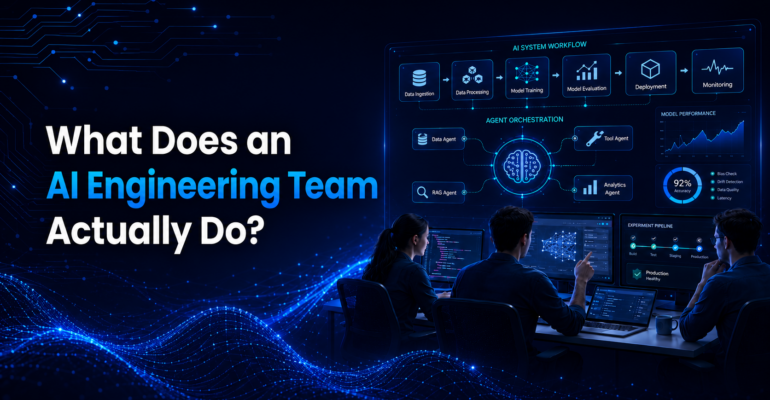
What Does an AI Engineering Team Actually Do?
 Brainiuminfotech
 One of the biggest misconceptions in tech right now is that AI products are powered mainly by the model.
They are not.
Most production AI systems succeed or fail because of the engineering around the model, not the model itself.
The public conversation around AI still revolves around prompts, chat interfaces, and model comparisons. But in practice, teams building and scaling real systems, including AI engineering teams in India and other global tech hubs, are dealing with a very different set of problems. Retrieval pipelines fail, AI agents misuse tools, context breaks across workflows, costs spiral unexpectedly, hallucinations appear in critical outputs, and systems that worked perfectly in demos become unreliable in production.
This is what AI engineering teams are really responsible for solving.
Their job is not just to “use AI.” It is to build the infrastructure, orchestration systems, guardrails, retrieval architecture, and operational controls that allow AI systems to function reliably in real environments.
As businesses move beyond experimentation, this engineering layer is quickly becoming the difference between AI that looks impressive and AI that actually works at scale.
Why AI Engineering is More Than Just Using an LLM API
The problem with most AI conversations right now is that they dramatically oversimplify what it takes to build usable AI systems.
Connecting to a large language model API has become relatively easy. That simplicity has created the illusion that AI products are mainly model-driven. In reality, most production AI failures happen outside the model itself.
An AI assistant may generate a convincing response during a demo. But once deployed into a real environment, entirely different challenges start appearing. The system now needs to retrieve accurate information from internal sources, maintain context across interactions, enforce permissions, validate outputs before execution, and coordinate with existing workflows without creating operational risk.
The model alone cannot manage any of that.
This is why AI engineering has evolved far beyond prompt design or API integration. Much of the work now revolves around building the systems responsible for controlling how AI behaves inside business environments.
That includes:
- Retrieval pipelines that supply accurate context
- Orchestration layers that manage tools and workflows
- Guardrails that restrict unsafe actions
- Observability systems that track failures and hallucinations
- Infrastructure layers that manage reliability, latency, and scale
These systems are not supporting components added around the model. In many cases, they determine whether the AI product works at all.
That shift is also changing the nature of software teams. AI engineering increasingly overlaps with backend architecture, DevOps, infrastructure systems, platform operations, and security engineering because production AI behaves less like a standalone feature and more like a live operational system running inside larger business workflows.
What Are the Core Responsibilities of an AI Engineering Team?
Once AI systems move from demos into production, the work stops looking like “building features” and starts looking like managing failure-prone systems that interact with real data, real users, and real business constraints.
That is where AI engineering becomes less about models and more about control systems around those models.
Retrieval Architecture
Retrieval is often treated as a “search problem,” but in production AI systems it behaves more like a ranking and trust problem.
The challenge is not fetching information. It is deciding what the model should trust when multiple sources conflict, overlap, or become outdated.
In real systems, retrieval architecture often fails in subtle ways:
- Highly ranked but incorrect documents get injected into context
- Outdated policies override newer internal updates
- Irrelevant but keyword-matching content dilutes reasoning quality
This is why AI engineering teams constantly tune retrieval for trustworthiness and context priority, often adding filters, re-ranking layers, and source hierarchies that reflect business reality rather than semantic similarity.
Agent Orchestration
Agent systems rarely fail because the model “cannot reason.” They fail because tool usage is poorly constrained.
In production, orchestration is where most unpredictability shows up:
- agents call the wrong tool with plausible intent
- workflows loop because intermediate outputs are misinterpreted
- APIs are triggered out of sequence, causing cascading failures
The core engineering decision here is not “can the AI use tools,” but how much autonomy is safe before the system becomes operationally unstable.
Teams typically end up balancing:
- Autonomy (faster task completion)
- Against control (predictable execution paths)
Most production systems quietly move away from full autonomy and toward semi-structured agent flows with strict checkpoints.
Prompt Infrastructure and Context Management
Prompts in production systems are not static instructions. They are dynamic assemblies of context, memory, retrieved data, and workflow state.
The real challenge is preventing context drift.
Common failure modes include:
- Irrelevant prior conversation influencing decisions
- Conflicting instructions between system layers
- Token overload pushing out critical context
- Hidden bias from earlier retrieved content
So AI engineering teams design prompt pipelines more like state management systems, where context is continuously shaped, filtered, and prioritized rather than simply appended.
AI Guardrails
Guardrails are operational boundaries that prevent AI systems from interacting incorrectly with business systems. The hardest problems here are not obvious attacks, but subtle failures:
- Prompt injection hidden inside legitimate-looking documents
- Indirect instruction hijacking through retrieved content
- Models interpreting ambiguous user intent as executable action
Because of this, guardrails are usually layered:
- Input-level filtering
- Context sanitization before retrieval injection
- Tool-level permission checks
- Output validation before execution
The stricter the guardrails, the less flexible the system becomes, but the more predictable it is in production.
Workflow Automation
Connecting AI to business workflows sounds straightforward until real operations enter the system. The issue is that business processes are not naturally AI-friendly. They assume determinism, while AI outputs are probabilistic.
This creates real failure points:
- AI triggers workflows with incomplete context
- Partially correct outputs still pass validation
- Automation chains amplify small reasoning errors into system-level failures
So AI engineering teams rarely allow direct execution. Instead, they introduce:
- Staged approvals
- Confidence thresholds
- Fallback routing to human review
- Constrained execution environments
The goal is controlled automation that degrades safely when AI is uncertain.
AI Observability and Evaluation
AI systems do not fail like traditional software. They fail inconsistently, even when inputs look identical. That makes debugging fundamentally different.
Instead of logs that show “what happened,” teams need systems that explain:
- Why the model behaved differently in similar cases
- Whether retrieval or reasoning caused the failure
- Whether tool choice or context selection was the root cause
This is why observability in AI systems includes:
- Trace-level execution tracking
- Prompt-version comparisons
- Retrieval inspection tools
- Output scoring models
Evaluation is not a post-deployment step. It becomes a continuous system that decides whether the AI behavior is still acceptable as data, prompts, and workflows evolve.
Deployment, Scaling, and Reliability
At scale, the main challenge is stability under cost and latency constraints. Production systems constantly make tradeoffs between:
- Cheaper models vs higher reasoning quality
- Cached responses vs fresh retrieval
- Latency vs multi-step reasoning depth
Failures often come from infrastructure pressure rather than model capability:
- Token spikes from long context chains
- Slow tool calls breaking user workflows
- Inconsistent routing between models under load
So AI engineering teams design systems that dynamically adjust behavior by:
- Routing simple tasks to lighter models
- Reserving heavier models for complex reasoning
- Caching repeatable workflows
- Enforcing fallback logic when tools fail
The goal is predictable performance under real-world constraints.
What is the Difference Between AI Engineering and Machine Learning Engineering?
The difference becomes clear only when you stop thinking in terms of “building AI” and start looking at where systems actually fail in production.
Machine learning engineering and AI engineering are not competing roles. They operate at different layers of the stack. One focuses on improving model intelligence through data and training. The other focuses on making that intelligence usable inside real systems that have constraints, users, and unpredictable inputs.
Machine learning engineering is primarily concerned with:
- Training and fine-tuning models using structured datasets
- Building and maintaining data pipelines
- Feature engineering and dataset preparation
- Improving prediction accuracy and model performance
- Optimizing learning algorithms and evaluation metrics
This layer is fundamentally model-centric. The core problem is improving how well the system learns from data under controlled conditions.
AI engineering starts after that point, where the model is no longer the bottleneck but the system behavior is.
AI engineering focuses on:
- Integrating models into real applications and workflows
- Building retrieval systems that supply external context at runtime
- Orchestrating tool and API interactions across services
- Managing context, memory, and multi-step execution flows
- Deploying AI systems under real latency, cost, and reliability constraints
The shift is not incremental but structural. Machine learning engineering operates in a relatively controlled environment where inputs, outputs, and objectives are well-defined. AI engineering operates in open environments where the system must handle missing context, conflicting data, tool failures, and ambiguous user intent.
This is why companies rarely choose between the two. Machine learning engineering improves what the model can learn. AI engineering determines whether that learning can survive contact with real-world systems.
How Do AI Engineering Teams Build AI Systems Around the Model?
Once AI moves into production, the model stops being the main challenge. The real work shifts to the systems that control what the model sees, what it can do, and how reliably it behaves inside real workflows.
AI engineering teams typically build three core layers around the model: retrieval systems, orchestration logic, and context management.
Retrieval Systems and Context Pipelines
Language models do not have access to internal or real-time company knowledge unless it is supplied at runtime. Retrieval systems solve this by feeding the model structured, relevant context from external sources.
In production, the real challenge is not fetching data, but controlling signal quality under conflicting or noisy sources. Poorly designed retrieval often causes hallucinations because the model is given plausible but unreliable context.
Agent Workflows and Tool Orchestration
Modern AI systems increasingly act as agents that interact with tools, APIs, and business systems. This introduces execution risk, not just generation risk.
AI engineering teams control:
- Which tools the model can access
- When tool calls are allowed
- How multi-step workflows are sequenced
- What permissions apply at each step
- How failures are handled safely
Without orchestration, agents tend to execute incorrect actions confidently rather than fail visibly.
Memory and Context Management
AI systems do not maintain stable state by default. Without explicit design, they lose priority signals, mix irrelevant history with current intent, or overload context windows.
AI engineering teams solve this by enforcing structured memory systems that prioritize relevant context, manage session continuity, and prevent information drift across interactions.
These three layers define how AI systems behave in production. In most real deployments, failures are not caused by the model itself, but by weaknesses in retrieval quality, execution control, or context consistency.
Why Do AI Systems Need Guardrails and Safety Layers?
The moment AI systems are connected to real data, tools, and workflows, the problem stops being about output quality. It becomes about control.
These systems don’t just “read” information but act on it, and the inputs they process are rarely clean. They come from users, documents, APIs, logs, and databases, often carrying instructions hidden in plain sight. If nothing restricts that flow, even a harmless-looking input can quietly steer system behavior in the wrong direction.
That’s where things start to break in production, and you might notice the following:
- Prompt injection disguised inside normal text
- Sensitive data leaking through retrieved context
- Agents calling tools they were never supposed to access
- Workflows getting triggered by the wrong intent
- Outputs that look correct but bypass validation rules and end up driving real actions
None of these failures feel dramatic at first. That’s what makes them dangerous.
Guardrails exist because of this gap between “what was meant” and “what the system actually executes.”
In practice, they aren’t a single safety layer. They’re distributed across the system:
- Filtering what enters the model in the first place
- Checking outputs before anything is executed
- Restricting which tools and data sources are even reachable
- Enforcing policy rules inside workflows, not outside them
- Isolating context so one session doesn’t contaminate another
- Introducing human checkpoints when the cost of a mistake is high
As AI systems become more autonomous and more deeply embedded into business operations, these controls stop feeling like extra safety features. They start functioning like basic infrastructure. Without them, the system doesn’t become “smarter.” It becomes unpredictable.
Why Most AI Demos Fail in Production
Even with guardrails in place, a working AI system in a demo environment doesn’t guarantee stability in production. The gap appears only when the system is exposed to real usage patterns at scale.
- Inputs stop being clean
- Users shift intent mid-flow
- Context comes from multiple conflicting sources
- External APIs fail without warning
- Latency fluctuates
- Costs spike
- Workflows break halfway through execution
These are normal infrastructure problems in isolation. In AI systems, they tend to amplify each other. A small retrieval mismatch can change the response. A delayed tool call can break a chain of actions. A weak context decision can silently alter downstream behavior without an obvious failure signal.
At that point, the issue is no longer model quality but a system design under real-world pressure.
A system that works in a demo can still fail in production without:
- Continuous monitoring of behavior and errors
- Evaluation systems to detect drift over time
- Fallback mechanisms for tool or model failure
- Workflow controls to prevent cascading breakdowns
- Infrastructure tuning for latency, cost, and scale
At scale, AI stops behaving like a feature and starts behaving like a connected system. That shift is why production readiness depends more on engineering discipline than model capability.
What Does AI Observability Actually Mean?
Once production failures become unavoidable, the next problem is rarely fixing them. It is figuring out where they actually originated.
That is the role of observability.
AI systems make this harder than traditional software because they do not fail in a single, predictable way. The same input can produce different outputs depending on retrieval results, tool responses, context selection, or model behavior at that moment. So instead of a clear error, teams often see drift, inconsistency, or partial breakdowns spread across multiple steps.
AI observability is the layer that makes those hidden system behaviors traceable.
It focuses on answering operational questions like:
- Where retrieval introduced incorrect or incomplete context
- Why outputs shifted or started hallucinating under similar inputs
- How instructions were overridden or misinterpreted in execution
- Why an agent selected a different tool than expected
- Where token usage or cost patterns suddenly changed
- At which step a workflow stopped behaving as intended
These issues rarely come from a single failure point. They usually sit across retrieval, orchestration, and model behavior, which is why they are difficult to isolate without structured visibility.
To make that traceable, AI observability systems typically rely on:
- Step-by-step execution traces across workflows
- Prompt and context change tracking over time
- Evaluation pipelines that compare output quality across versions
- Tool and workflow logs for agent actions
- Human review loops for ambiguous or high-risk outputs
- Scoring systems for consistency and reliability
- Latency and cost monitoring across all components
Without this layer, production systems become difficult to debug because failures are visible only at the output level, not at the point where they actually originate.
Why AI Engineering is Becoming an Infrastructure Discipline
Once observability makes system behavior visible, a clearer pattern emerges. The hardest problems in production AI are structural limits in how the system is designed, connected, and operated.
That is the point where AI engineering stops looking like application development and starts behaving like infrastructure work.
As AI systems move deeper into business operations, the responsibility shifts from building features to running systems under real constraints. Teams are no longer just integrating models; they are accountable for how those models behave when exposed to scale, cost pressure, and operational risk.
In practice, AI engineering teams end up owning:
- System reliability across multi-step AI workflows
- Scalability under unpredictable usage patterns
- Governance over data access and tool permissions
- Security across inputs, outputs, and integrations
- Performance tuning under latency constraints
- Cost control across model usage and tool calls
- Coordination across interconnected AI-driven processes
This is also why the role is increasingly being placed closer to platform and infrastructure teams rather than experimental AI or research functions. The overlap with cloud infrastructure, backend systems, DevOps, and platform engineering is no longer indirect but is operational.
The shift is visible in how teams now evaluate success. It is no longer enough to ask whether an AI system produces useful outputs in controlled conditions. The real question is whether it continues to behave reliably when embedded into live systems with users, tools, and operational dependencies.
That change in expectation is what is steadily turning AI engineering into an infrastructure discipline rather than a feature-level capability.
What Do Strong AI Engineering Teams Actually Prioritize?
As AI engineering fully shifts into an infrastructure discipline, the evaluation criteria also become more concrete. At that stage, teams are judging whether a system behaves predictably when everything around it is unstable, such as inputs, tools, users, and scale.
That is where priorities start to converge.
Strong AI engineering teams consistently optimize around a small set of operational constraints:
Reliability
Outputs must remain consistent across changing inputs and workflows. If behavior varies unpredictably, the system is not production-ready, regardless of model quality.
Observability
Failures need to be traceable to a specific layer like retrieval, context, tool execution, or model behavior. Without that visibility, debugging becomes guesswork.
Safety
The system must resist unsafe or unintended actions even when inputs are ambiguous, adversarial, or incomplete. This includes controlling tool access and preventing harmful outputs from reaching execution layers.
Scalability
The system must hold under real load conditions, such as concurrent users, parallel workflows, and fluctuating request volume, without degrading behavior or response quality.
Adaptability
Business rules, models, and workflows will change. The system has to absorb those changes without requiring structural redesign every time something evolves.
These priorities matter more than model selection itself. In production environments, even the most capable model fails if the surrounding system cannot control its behavior, interpret its failures, or maintain stability under pressure.
What is the Future of AI Engineering?
As AI systems move deeper into real business environments, the focus is no longer shifting toward better models alone. It is shifting toward systems that can hold their behavior steady under real operational pressure.
That pressure comes from everywhere at once, such as enterprise workflows, automation pipelines, customer-facing systems, internal tools, and decision support layers. Each environment adds constraints that cannot be solved by model improvements in isolation.
This is why AI engineering is becoming less about experimentation and more about system design at scale. The teams that will matter most are not the ones optimizing model outputs in controlled settings, but the ones building the layers that keep those outputs reliable when the system is fully exposed to production reality.
Over time, this is pushing the discipline toward a clearer direction: AI systems are judged less by how capable they appear in isolation, and more by how consistently they behave when embedded into real workflows with real consequences.
In Conclusion,
The real shift in AI engineering is responsibility moving away from the model and into the system around it. Most failures in production AI do not come from weak models. They come from missing structure: unclear context boundaries, uncontrolled tool access, unobserved failures, and workflows that were never designed for probabilistic behavior.
AI engineering exists to close that gap.
It turns language models into operational systems by adding the parts most users never see but every production system depends on, such as controlled retrieval, governed execution, observable behavior, and enforceable constraints.
This is exactly the direction AI engineering teams in India and globally are now moving toward as AI systems become core to real business infrastructure.
When those layers are missing, AI remains a demo. When they are built well, AI becomes infrastructure.
To move from prototypes to production-ready systems, deploy Brainium’s AI engineering team in India to design, build, and scale reliable AI infrastructure for your business.
Frequently Asked Questions
1. What does an AI engineering team actually do?
An AI engineering team builds the systems that make AI usable in production. This includes retrieval pipelines, orchestration layers, guardrails, observability systems, and deployment infrastructure that ensure AI behaves reliably inside real business workflows.
2. Is AI engineering the same as machine learning engineering?
No. Machine learning engineering focuses on training and improving models using data, features, and optimization. AI engineering focuses on integrating those models into production systems with retrieval, tools, workflows, and operational controls.
3. Why is AI engineering important for production systems?
Because models alone cannot handle real-world conditions. Production systems involve unpredictable inputs, tool failures, latency constraints, and security risks. AI engineering ensures these systems remain stable, safe, and controllable at scale.
4. Why do AI demos fail in production?
AI demos run in controlled environments with clean inputs and predictable flows. Production environments introduce messy data, shifting user intent, API failures, cost limits, and scaling pressure that expose system design weaknesses rather than model issues.
5. What is AI observability?
AI observability is the ability to trace and understand how an AI system behaves in production. It tracks failures across retrieval, tool execution, and model decisions using logs, evaluations, and execution traces to identify where and why issues occur.
6. Why do AI systems need guardrails?
AI systems interact with untrusted inputs and external tools, which creates risks like prompt injection, data leakage, and unauthorized actions. Guardrails enforce constraints through filtering, permissions, validation, and controlled execution to keep behavior safe and predictable.
7. Why is AI engineering becoming an infrastructure discipline?
Because AI is now embedded into core business operations. These systems must handle scale, reliability, governance, security, and cost constraints. This shifts AI engineering closer to infrastructure roles like DevOps, platform engineering, and backend systems.
8. What makes an AI system production-ready?
A production-ready AI system is defined by more than model quality. It requires reliable retrieval, controlled tool execution, observability, fallback mechanisms, and infrastructure that can handle real-world scale and failure conditions.
9. What are the core components of an AI engineering system?
The core components are retrieval systems for context, orchestration layers for tool and workflow control, guardrails for safety enforcement, and observability systems for monitoring and debugging system behavior in production.
10. What is the difference between AI demos and real AI systems?
AI demos operate in controlled environments with predictable inputs. Real AI systems operate in production environments with unstable data, user variability, tool failures, and scaling pressure. The difference lies in system design, not model capability.