
Why AI Search Rewards Topic Clusters More Than Individual Blog Posts
Why AI Search Rewards Topic Clusters More Than Individual Blog Posts
 Brainiuminfotech
 AI-powered search systems like Google AI Overviews and AI Mode are changing how content is discovered and selected. Instead of relying on individual blog posts ranking for isolated keywords, these systems evaluate whether a website demonstrates comprehensive topical understanding across an entire subject area.
This shift means that visibility is no longer determined only by rankings. Content must also be usable in AI-generated answers, which requires clarity, contextual depth, and strong semantic relationships between pages.
As businesses adapt their websites to meet these evolving requirements, many choose to hire WordPress developers in India to improve content architecture, internal linking, and overall site structure.
What is a Topic Cluster?
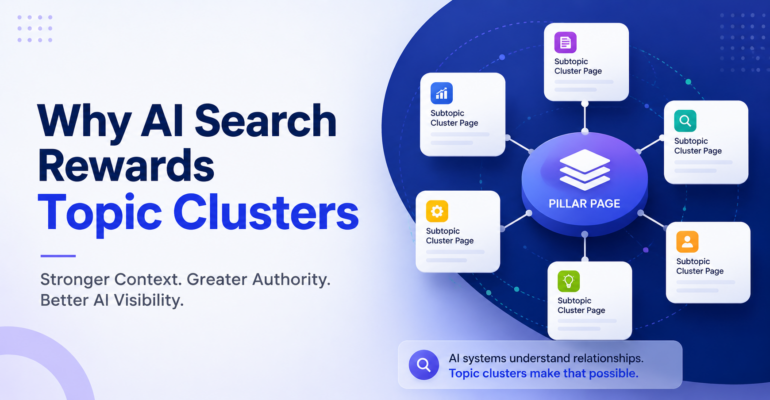
A topic cluster is a content architecture where a central pillar page covers a broad subject, supported by multiple interlinked articles that each focus on specific subtopics in depth.
This structure is designed for modern search systems that no longer evaluate content at the page level alone. Instead, AI-driven systems like Google AI Overviews and AI Mode interpret how well a website covers an entire topic through connected content, not isolated pages.
Because of this shift, the traditional model of publishing standalone blog posts targeting individual keywords is no longer sufficient for establishing topical authority.
To understand how topic clusters solve this, it is important to break the model into its core components.
I. Pillar Page (Central Topical Anchor)
At the center of every topic cluster is the pillar page. It acts as the primary reference point for the topic and provides a structured overview of the subject while organizing and distributing authority across all related subtopics.
Rather than going deep into every detail, its function is to define the topic space and connect all supporting content into a single interpretative structure for both users and AI systems.
II. Cluster Pages (Distributed Depth Layer)
Connected to the pillar page are cluster pages, which handle depth. Each cluster page focuses on a single subtopic related to the broader theme and expands it with detailed, intent-specific information.
In practice, cluster pages:
- Target focused queries within the broader topic
- Expand specific aspects of the pillar subject
- Reinforce topical coverage through contextual linking
This allows the topic to be explored in layers rather than in isolation, which aligns with how AI systems interpret informational completeness.
III. Internal Linking Logic (Relationship Mapping Layer)
The structure becomes effective only when these pages are connected through intentional internal linking. This linking system creates a clear relationship map:
- Cluster pages reinforce the pillar page as the central authority
- The pillar page distributes context back to cluster pages
- Related cluster pages reinforce semantic connections within the topic
This is not just a navigation structure. It is how AI systems infer topical boundaries, depth, and authority across a website.
Of course, understanding how a topic cluster is structured explains only part of its value. The more important question is why this model is becoming increasingly effective in AI-powered search.
The answer lies in how modern AI systems evaluate information. Unlike traditional search engines, which can rank a page based on relevance to a specific query, AI systems must determine whether they have enough context to confidently generate an answer. This creates challenges for websites that rely primarily on isolated articles rather than interconnected content ecosystems.
Why Isolated Blog Posts Struggle in AI Search
A standalone article can still rank well for a specific query. However, ranking and AI visibility are becoming increasingly different outcomes.
Traditional search primarily evaluates whether a page is relevant to a user’s query. AI-powered search must go further. It needs to understand how a topic relates to adjacent concepts, whether important context is missing, and whether the source demonstrates expertise beyond a single page.
This is where isolated content often encounters limitations.
I. Lack of Contextual Depth
Most individual blog posts are designed to answer a single question or satisfy a specific search intent. For example, a standalone article may answer:
- What is a topic cluster?
- How do topic clusters work?
- What are the benefits of topic clusters?
Each page may perform well independently. However, AI systems frequently need information that extends beyond a single intent.
When generating answers, AI models often evaluate:
- Definitions
- Comparisons
- Benefits
- Limitations
- Related concepts
- Implementation guidance
A single article rarely covers all of these areas comprehensively. As a result, AI systems may struggle to determine whether the page represents a complete understanding of the subject or only one portion of it.
This does not necessarily reduce rankings. It can, however, reduce confidence when AI systems are deciding which sources to reference within generated responses.
II. Weak Semantic Relationships
AI systems do not evaluate pages in isolation. They also analyze how information is connected across a website. When content exists as independent articles with minimal internal relationships, AI receives fewer signals about:
- Topic hierarchy
- Concept relationships
- Subject boundaries
- Areas of expertise
This creates a fragmented content graph.
By contrast, interconnected content helps establish clear semantic relationships between concepts. A page about topic clusters that links to supporting content about pillar pages, internal linking, topical authority, and content architecture provides significantly more contextual information than a standalone article covering only one of those subjects.
The difference is not simply more content. It is clearer evidence of how concepts relate to one another.
III. Limited Authority Formation
AI systems increasingly evaluate expertise at the topic level rather than solely at the page level.
A single article may demonstrate knowledge about one subject. However, authority is often formed through repeated evidence across multiple related pieces of content.
For example, publishing one article about ecommerce SEO signals relevance. But publishing interconnected content creates a broader and more consistent expertise footprint, especially when you cover:
- Ecommerce SEO
- Technical SEO
- Product page optimization
- Internal linking
- Structured data
- AI search visibility
Over time, these recurring thematic signals help AI systems build a stronger understanding of what a website specializes in.
This distinction is important because AI-generated answers increasingly depend on source confidence. The more evidence a website provides that it consistently covers a topic in depth, the easier it becomes for AI systems to treat that website as a reliable source of information within that subject area.
How AI Systems Actually Understand Topics
Many SEO discussions still focus on how pages rank. However, AI-powered search systems are increasingly focused on understanding topics.
Rather than evaluating a page independently, AI systems attempt to understand how concepts, entities, and information connect across a website. This allows them to assess not only whether a page is relevant, but whether the source demonstrates meaningful expertise on the topic being discussed.
I. AI Builds Topic Graphs, Not Page Lists
Traditional search systems primarily evaluated documents. AI-powered systems increasingly evaluate relationships.
Instead of viewing content as a collection of separate pages, AI attempts to build a topic graph, which is a network of connected entities, concepts, products, and categories.
For example, a website that publishes content about Shopify SEO, site architecture, structured data, product page optimization, and collections optimization provides AI with multiple signals about the same subject area. These relationships help AI understand how topics connect and where expertise exists.
This shift is important because AI visibility is increasingly influenced by topic-level understanding rather than page-level relevance alone.
II. How AI Systems Build Topic Understanding
While the exact methods vary across platforms, AI systems generally follow a similar process when evaluating topical expertise.
Entity Identification
The first step is identifying important entities within the content. These entities may include:
- Products
- Brands
- Services
- Technologies
- Industries
- Concepts
In a Shopify SEO article, entities might include Shopify, structured data, product pages, collections, crawling, indexing, and AI search.
Relationship Mapping
Once entities are identified, AI analyzes how they relate to one another.
A website that consistently explains how structured data affects product visibility, how site architecture influences crawling, and how collections impact internal linking creates a clearer understanding of the broader topic than a website that discusses these concepts separately without context.
Consistency Validation
AI systems also look for consistency across multiple pages.
When related concepts, terminology, and explanations appear repeatedly throughout a website, confidence increases. Consistent coverage helps AI determine that expertise is part of the site’s overall knowledge base rather than limited to a single article.
III. Why Repeated Coverage Matters More Than a Single Great Article
A comprehensive article can demonstrate knowledge about a topic. Repeated coverage demonstrates understanding of the topic ecosystem.
For example, a single guide about Shopify SEO may show that a website understands the subject. However, when you provide supporting content, they provide stronger evidence of sustained expertise. In this case, when writing about Shopify SEO, you may also include topics related to
- Technical SEO
- Structured data
- Collections
- Product optimization
- Site architecture
- AI search
This matters because AI systems are increasingly evaluating whether a website consistently understands a topic, not simply whether it has published one strong page.
The more related concepts a website covers accurately and consistently, the easier it becomes for AI systems to associate that website with expertise in the broader subject area.
Topic Clusters vs Individual Posts: What’s the Difference?
The way AI systems evaluate expertise creates a clear advantage for topic clusters over standalone articles.
Rather than signaling knowledge through a single page, topic clusters create multiple interconnected signals that reinforce topical understanding across a website.
The differences become clearer when comparing the two approaches directly.
| Factor | Individual Blog Post | Topic Cluster |
| Coverage Depth | Covers a single topic or question | Covers multiple related aspects of a topic |
| Internal Linking | Limited contextual connections | Strong network of interconnected pages |
| AI Interpretability | Provides isolated information | Provides context and relationships between concepts |
| Ranking Stability | Dependent on the performance of one page | Supported by multiple reinforcing assets |
| Long-Tail Coverage | Targets a narrow set of queries | Captures a wider range of related searches |
| Topical Authority | Signals knowledge of one subject | Signals expertise across an entire topic area |
The key difference is that individual posts operate as content assets, while topic clusters operate as knowledge systems.
A single article can answer a specific question effectively. A topic cluster helps AI understand how related concepts connect, how deeply a topic is covered, and whether expertise is demonstrated consistently across the website.
As AI search becomes increasingly focused on topic-level understanding, these signals become significantly more valuable than the performance of any individual page.
Why Topic Clusters Align with AI Overviews and AI Mode
Topic clusters are not valuable simply because they improve site structure or internal linking. Their real advantage is that they align closely with how modern AI-powered search systems retrieve, validate, and synthesize information.
As AI-generated answers become more common, visibility increasingly depends on reducing uncertainty. The easier it is for AI systems to understand a topic, validate supporting information, and connect related concepts, the easier it becomes to use that information confidently within generated responses.
I. Topic Clusters Support Stronger Information Validation
AI-generated answers are rarely built from a single piece of information in isolation. Before presenting a response, AI systems typically evaluate multiple related signals to determine whether information is consistent, complete, and trustworthy.
This is where topic clusters create an advantage.
A standalone article may provide one explanation of a topic. However, a topic cluster provides multiple supporting pages that reinforce related concepts from different angles.
For example, a pillar page about Shopify SEO may be supported by dedicated articles covering structured data, site architecture, product page optimization, and indexing. Together, these pages create a broader body of evidence than any single article can provide alone.
The result is a stronger and more consistent topical signal.
II. Topic Clusters Support Multi-Query Search Journeys
AI Mode is designed around conversation rather than individual searches. Users often begin with a broad question, then refine their requirements through follow-up queries, comparisons, and requests for deeper explanations.
For example, a user may move from:
- How does Shopify SEO work?
- What is Shopify schema markup?
- How do collections affect rankings?
- How can Shopify stores improve AI search visibility?
Although these are separate questions, they belong to the same broader topic.
A topic cluster naturally supports this progression because related information already exists across interconnected pages. This makes it easier for AI systems to access supporting context as user conversations evolve.
As search becomes more conversational, content structures that support multiple connected questions become increasingly valuable.
III. Topic Clusters Create Supporting Evidence Networks
One challenge in AI-generated search is confidence. Before presenting information, AI systems must determine whether a claim is supported by sufficient context and evidence.
Topic clusters help address this challenge by creating what can be thought of as supporting evidence networks. Rather than relying on a single page to establish expertise, AI can observe related explanations, supporting examples, and deeper coverage across multiple connected resources.
Each page contributes additional context that helps reinforce the broader topic. This does not guarantee inclusion in AI-generated answers, but it helps reduce ambiguity and makes expertise easier to verify.
To put it simply, the strongest benefit of topic clusters is not rankings, internal links, or content volume. It is their ability to reduce uncertainty.
By providing broader coverage, stronger contextual relationships, and multiple layers of supporting information, topic clusters make it easier for AI systems to understand a topic and evaluate the expertise behind it. As AI-powered search continues to evolve, that reduction in uncertainty may become one of the most important factors influencing visibility.
How Topic Clusters Improve AI Extractability
The advantages of topic clusters extend beyond visibility. They also influence how easily AI systems can extract, interpret, and reuse information when generating answers.
This distinction matters because AI search is not simply retrieving pages. It is continuously selecting, combining, and validating information from multiple sources to answer increasingly complex queries.
The easier a website makes that process, the more likely its content is to be surfaced within AI-generated responses.
I. Entity Reinforcement Across Pages
AI systems rely heavily on entities to understand content. An entity can be a product, brand, concept, technology, feature, industry term, or any identifiable topic that can be connected to other topics.
When an entity appears repeatedly across multiple related pages, AI gains additional context about how that entity relates to the broader subject area. For example, a website focused on Shopify SEO may consistently discuss concepts such as:
- Shopify structured data
- Product schema
- Merchant Center feeds
- Internal linking
- AI search visibility
On an isolated page, these concepts may appear as individual references. Across a topic cluster, however, they become part of a larger semantic network.
Each supporting page adds context, examples, use cases, and relationships that help AI understand not only what each entity is, but how it connects to the overall topic. As a result, topic clusters create stronger entity signals than standalone articles, which often discuss concepts only once and in limited depth.
II. Internal Linking Creates Semantic Pathways
Internal links are often discussed as a navigation feature. For AI systems, they serve a more important purpose. They help establish relationships between topics.
When a pillar page links to supporting articles, and those supporting articles link back to related resources, the site begins to communicate how different concepts fit together.
For example, a pillar page about AI SEO may connect to dedicated articles covering:
- Topic clusters
- Structured data
- Entity optimization
- Internal linking strategies
- AI Overviews
This linking structure provides contextual signals that help AI understand which topics belong within the same knowledge area. Rather than evaluating each page independently, AI can follow these connections to build a more complete understanding of the subject being covered.
In this way, internal links function less as navigation elements and more as semantic pathways that reveal topical relationships.
III. Content Layering Mirrors AI Reasoning Depth
AI systems rarely answer complex questions using a single piece of information. Instead, they assemble answers from multiple layers of knowledge.
Topic clusters naturally support this process through content layering. A well-structured cluster typically includes:
| Content Layer | Purpose |
| Pillar page | Explains the core topic comprehensively |
| Supporting pages | Explore major subtopics in depth |
| Specialized pages | Address niche questions, comparisons, and edge cases |
This structure mirrors how AI systems evaluate topics.
A broad query may draw context from the pillar page, while more specific questions can be supported by cluster content that addresses narrower user intents. Because information exists at multiple levels of depth, AI can retrieve context that is appropriate to the complexity of the query rather than relying on a single page to answer everything.
IV. Reduced Ambiguity Across the Topic Space
One of the biggest challenges in AI-generated search is ambiguity. A single article often has limited space to define concepts, explain distinctions, address exceptions, and cover related questions.
As a result, important context is frequently omitted.
Topic clusters distribute this responsibility across multiple pages. Instead of forcing one article to explain every aspect of a subject, individual pages can focus on clearly defining specific concepts, use cases, comparisons, or problems.
Over time, this creates a more complete representation of the topic. For AI systems, that completeness reduces the amount of interpretation required. The definitions become clearer, relationships become easier to verify, and the context becomes easier to retrieve.
The result is a knowledge structure that is easier for AI to understand, reference, and incorporate into generated answers.
The cumulative effect of these signals is that topic clusters become easier for AI systems to interpret, validate, and retrieve. But understanding why clusters work is only part of the equation. The next challenge is implementation: what does an AI-friendly topic cluster actually look like in practice?
What a High-Performing Topic Cluster Looks Like
Understanding the theory behind topic clusters is useful, but implementation is where AI visibility is ultimately won or lost.
Many websites publish content around a topic without intentionally structuring it as a cluster. They may have dozens of related articles, yet AI systems still struggle to identify a coherent area of expertise because the relationships between those articles are weak or unclear.
A high-performing topic cluster solves this problem by organizing content around a central topic while systematically covering the supporting concepts that AI systems expect to see.
Consider a website targeting the topic of Shopify SEO in the era of AI-powered search.
| Content Type | Example Topic |
| Pillar Page | Shopify SEO in the AI Search Era |
| Cluster Page | How AI Overviews Impact Ecommerce Visibility |
| Cluster Page | Structured Data for Shopify Stores |
| Cluster Page | Product Page Optimization for Google AI Mode |
| Cluster Page | Internal Linking for Semantic SEO |
| Cluster Page | Entity SEO for Ecommerce Brands |
At first glance, these pages may appear to cover different subjects. In reality, they are all contributing to the same topical ecosystem.
The pillar page establishes the broader subject area: how Shopify SEO is evolving as search becomes increasingly AI-driven. The supporting pages then expand specific dimensions of that topic.
For example:
- The AI Overviews article explains how AI-generated answers influence visibility.
- The structured data article explains how machine-readable information improves interpretation.
- The product page optimization article focuses on content quality and recommendation readiness.
- The internal linking article explains how relationships between topics are communicated.
- The entity SEO article explores how brands, products, and concepts are understood within AI systems.
Individually, each article answers a different question. But collectively, they create a comprehensive representation of the broader topic.
This distinction is important because AI systems rarely evaluate expertise through a single page. Instead, they assess how consistently a website covers the concepts that define a subject area.
A website that publishes only one article about Shopify SEO may demonstrate relevance for that specific query. On the other hand, a website that covers AI Overviews, structured data, entity optimization, semantic SEO, product content strategy, and related concepts begins to demonstrate subject depth.
Why Topic Clusters Will Become More Important as AI Search Evolves
AI search is moving toward deeper reasoning, longer conversational journeys, and more complex information synthesis. As this happens, AI systems need stronger evidence that a website understands a subject beyond a single page.
Topic clusters provide that evidence by connecting related concepts into a coherent knowledge structure. Rather than evaluating isolated articles, AI can evaluate how topics, entities, and supporting information reinforce one another across an entire site.
This is one reason topic clusters are becoming increasingly important. They do not simply improve content organization. They help transform a website from a collection of pages into a source of topical expertise that AI systems can interpret with greater confidence.
In Conclusion,
As AI search continues to evolve, visibility is becoming less dependent on individual pages and more dependent on how effectively a website demonstrates subject expertise. AI systems are increasingly tasked with interpreting relationships between concepts, evaluating topical depth, and identifying sources that provide comprehensive coverage rather than isolated answers.
This is why topic clusters are becoming a critical content strategy. They help transform content from a collection of standalone articles into a structured knowledge ecosystem that is easier for AI systems to interpret, connect, and reference. By covering related concepts through interconnected pages, businesses create stronger signals of expertise and provide the contextual depth that modern search experiences increasingly rely on.
For organizations investing in long-term organic growth, the goal is no longer simply to publish more content. It is to build a content structure that helps both users and AI systems understand the depth and breadth of your expertise.
At Brainium, we help businesses build AI-ready content ecosystems that improve discoverability, authority, and long-term search performance. Whether you’re expanding an existing content strategy or looking to hire WordPress developer in India to support large-scale topic cluster implementation, our team can help you create content structures designed for the future of AI-powered search.
Frequently Asked Questions
1. What is a topic cluster in SEO?
A topic cluster is a content structure where a central pillar page is supported by multiple interlinked articles covering related subtopics. This helps search engines and AI systems understand the depth, context, and relationships within a subject area.
2. Why do topic clusters perform better in AI search than individual blog posts?
Topic clusters provide broader topical coverage and stronger semantic relationships than standalone articles. This helps AI systems evaluate expertise, connect related concepts, and generate answers with greater confidence.
3. How do topic clusters improve visibility in Google AI Overviews?
Topic clusters make it easier for AI systems to validate information across multiple related pages. By providing supporting context and comprehensive coverage, they increase the likelihood of content being considered for AI-generated summaries and responses.
4. What is the difference between a pillar page and a cluster page?
A pillar page covers a broad topic and acts as the central hub of a content cluster. Cluster pages focus on specific subtopics and link back to the pillar page, creating a structured network of related content.
5. How does internal linking help AI understand content?
Internal links help AI systems identify relationships between topics, concepts, and entities across a website. They provide contextual signals that strengthen topic understanding and reinforce topical authority.
6. Are topic clusters important for Google AI Mode?
Yes. Google AI Mode is designed around conversational search journeys that often involve multiple related questions. Topic clusters support these journeys by providing interconnected content that covers a topic from different angles.
7. How do AI systems determine topical authority?
AI systems evaluate factors such as content depth, topic coverage, semantic relationships, entity connections, and consistency across multiple pages. Websites that cover a subject comprehensively are generally easier for AI systems to recognize as authoritative.
8. Can topic clusters increase the chances of appearing in AI-generated answers?
While no strategy guarantees inclusion, topic clusters help improve the contextual depth, clarity, and topical signals that AI systems use when selecting sources for AI-generated answers.