How AI is Transforming WordPress Website Development in 2026
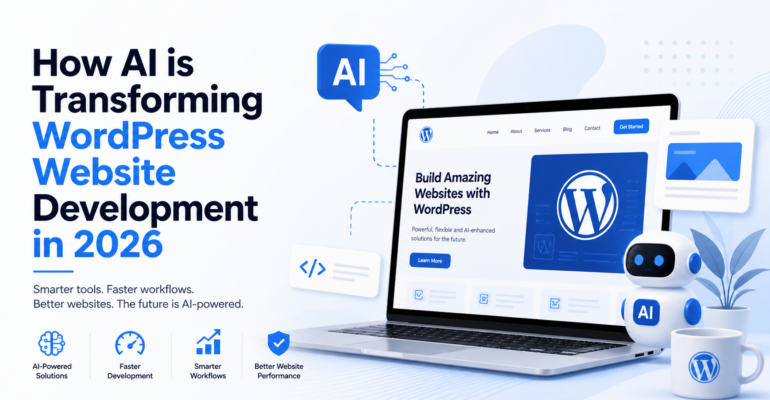
How AI is Transforming WordPress Website Development in 2026
 Brainiuminfotech
 Artificial intelligence is fundamentally reshaping WordPress website development in 2026, transforming how businesses build, optimize, secure, and scale their digital presence. As WordPress continues to power a major share of the global web, AI integration is rapidly shifting the platform from a traditional content management system into an intelligent digital ecosystem capable of automation, predictive optimization, and personalized user engagement.
Businesses today face growing pressure to launch faster, rank higher, convert better, and manage increasingly complex customer journeys. AI addresses these challenges by streamlining design workflows, automating SEO, improving content production, strengthening cybersecurity, enabling predictive analytics, and enhancing user experiences at scale.
At the same time, search engine evolution including AI Overviews, conversational search, and generative search experiences—is changing how WordPress websites must be structured for visibility.
In 2026, AI is no longer an optional competitive advantage for WordPress websites. It is becoming essential infrastructure for businesses seeking sustainable digital growth.
This guide explores the most important ways AI is transforming WordPress website development, the technologies leading this evolution, and how businesses can strategically future-proof their websites.
Quick Answer: How Is AI Transforming WordPress Website Development in 2026?
AI is transforming WordPress website development in 2026 by automating website design, improving SEO performance, accelerating content creation, personalizing user experiences, strengthening security, streamlining maintenance, enabling predictive analytics, supporting no-code development, and optimizing websites for evolving AI-powered search ecosystems.
Businesses that strategically integrate AI into WordPress development can significantly improve efficiency, discoverability, customer engagement, and long-term scalability.
What AI-Powered WordPress Development Means in 2026
AI-powered WordPress development in 2026 refers to the integration of technologies like machine learning, generative AI, predictive analytics, and automation tools across website creation, optimization, management, and performance improvement.
Unlike traditional WordPress workflows that depend heavily on manual processes for design, SEO, content, and maintenance, AI-powered systems enable websites to automate tasks, analyze user behavior, and continuously improve digital experiences.
This shift is transforming WordPress from a conventional CMS into a more intelligent, adaptive platform capable of supporting faster growth and smarter business operations.
Core AI Capabilities in Modern WordPress Development
Key AI-driven functions now include:
- Automated design generation
- AI-assisted coding
- Predictive SEO optimization
- Content generation
- Semantic search readiness
- Dynamic personalization
- Security automation
- Predictive maintenance
- Accessibility enhancements
- Conversational interfaces
For businesses, this transition represents a move from static website management to more agile digital ecosystems that support:
- Faster deployment
- Smarter optimization
- Better conversions
- Enhanced scalability
- Reduced operational overhead
In 2026, AI-powered WordPress development is becoming a strategic necessity for businesses seeking stronger performance, improved discoverability, and long-term digital competitiveness.
Why AI Is Becoming Essential for WordPress Website Development
AI adoption in WordPress development is accelerating because it directly addresses the growing operational, marketing, and performance demands businesses face in an increasingly competitive digital ecosystem. In 2026, AI is no longer simply a tool for automation. It is becoming foundational to how WordPress websites are built, optimized, and scaled for long-term success.
As businesses compete for visibility across traditional search engines, AI Overviews, conversational search, and increasingly personalized user experiences, WordPress websites must evolve beyond conventional development practices. AI helps bridge this gap by improving efficiency, discoverability, customer engagement, and overall digital competitiveness.
1. Rising Demand for Faster Development Cycles
Modern businesses require websites that can launch, adapt, and scale more quickly than ever before.
Key priorities include:
- Faster website deployment
- Reduced development costs
- Automated workflows
- Scalable website management
- Continuous optimization
AI-powered design, coding, and content generation tools help reduce repetitive workloads, accelerate production timelines, and improve overall development efficiency.
2. Search Engines are Prioritizing Smarter, AI-Optimized Content
Search is rapidly evolving beyond traditional keyword strategies. In 2026, WordPress websites must increasingly align with:
- AI Overviews
- Semantic indexing
- Conversational search
- Voice search optimization
- Schema-driven discoverability
This means businesses need better structured content, stronger SEO precision, and machine-readable digital frameworks.
AI helps WordPress websites optimize for these new search ecosystems while improving visibility across both human and AI-powered discovery channels.
3. User Experience Expectations are Increasing
Today’s website visitors expect digital experiences that are more intelligent, personalized, and frictionless.
Modern users increasingly demand:
- Personalized interactions
- Faster load times
- Intelligent on-site search
- Instant customer support
- Adaptive content journeys
AI enables WordPress websites to meet these expectations through dynamic personalization, predictive optimization, and automated customer engagement systems.
4. Competitive Pressure is Increasing Across Digital Markets
Businesses that integrate AI into WordPress development often gain measurable advantages in:
- SEO performance
- Content scalability
- Conversion optimization
- Security resilience
- Customer retention
- Operational efficiency
Companies that delay AI adoption may face slower growth, weaker discoverability, and reduced competitiveness as digital ecosystems increasingly reward intelligent, adaptive websites.
Thus, AI is becoming essential for WordPress website development because it strengthens not only operational efficiency, but also search visibility, conversion potential, user engagement, and long-term scalability.
In 2026 and beyond, businesses that strategically integrate AI into WordPress development will be better positioned to compete, grow, and future-proof their digital presence.
Core Ways AI Is Transforming WordPress Website Development
Successfully integrating AI into WordPress development requires understanding how artificial intelligence impacts every stage of the website lifecycle, which includes stages from design and content creation to SEO, security, user engagement, and long-term optimization.
In 2026, AI is not reshaping just one aspect of WordPress development. It is fundamentally improving how websites are built, managed, scaled, and optimized for performance. Businesses that strategically adopt AI across multiple development layers can achieve faster production, stronger search visibility, better user experiences, and improved operational efficiency.
1. AI-Powered Website Design and Development Automation
AI is significantly reducing the time, cost, and complexity involved in WordPress website design and development. Traditional workflows often require extensive manual effort across layout creation, design refinement, coding, and testing. AI-powered tools now automate many of these tasks, allowing businesses and developers to build websites more efficiently.
Major applications Include:
- Automated layout generation
- Intelligent design suggestions
- AI-assisted code generation
- Template personalization
- UX optimization recommendations
- Accessibility enhancements
Popular AI Development Tools
| Tool | Primary Function | Key Benefit |
| Elementor AI | Design + content | Faster page creation |
| Divi AI | Website generation | Streamlined design |
| 10Web AI Builder | Automated site building | Rapid deployment |
| CodeWP | AI coding support | Improved developer efficiency |
AI-powered development automation accelerates website production while improving precision, scalability, and design performance. This enables businesses to reduce bottlenecks, improve launch speed, and create more sophisticated WordPress websites with fewer manual resources.
2. AI-Driven Content Creation and SEO Optimization
Content remains one of the most critical drivers of WordPress website performance, but AI is dramatically transforming how content is produced, optimized, and scaled.
In 2026, AI tools help businesses create more strategic, search-friendly content while improving efficiency across SEO workflows.
AI Enhancements Include:
Blog generation
Metadata optimization
Keyword clustering
Content briefs
Schema recommendations
SEO audits
Readability improvements
Key Benefits:
Businesses leveraging AI for WordPress content strategies can achieve:
- Faster publishing cycles
- Improved organic search visibility
- Greater content scalability
- Enhanced semantic SEO performance
- Better alignment with AI Overviews and conversational search
While AI improves speed and optimization, human oversight remains essential to ensure:
- Originality
- Accuracy
- Brand consistency
- EEAT compliance
That’s why the most successful strategies combine AI efficiency with expert editorial direction.
3. Personalized User Experiences Through AI
AI is transforming WordPress websites from static digital experiences into dynamic, personalized platforms that adapt to individual user behavior. As consumer expectations increase, personalization is becoming central to website competitiveness.
Key Personalization Applications Include:
- Dynamic content recommendations
- Behavioral targeting
- Product suggestions
- Smart calls-to-action
- Personalized email journeys
- Audience segmentation
Business Impact:
AI-driven personalization can significantly improve:
- Session duration
- Conversion rates
- Customer retention
- Engagement quality
- Lead nurturing performance
By delivering more relevant digital experiences, businesses can improve customer satisfaction while maximizing revenue opportunities.
4. AI for Website Security and Maintenance
Website security and maintenance remain major priorities for WordPress businesses, particularly as cyber threats grow more sophisticated. AI is increasingly strengthening WordPress security through predictive threat monitoring and automated maintenance systems.
Core AI Security Functions Include:
- Malware detection
- Threat prediction
- Login anomaly monitoring
- Vulnerability assessments
- Automated backups
- Plugin conflict detection
Operational Benefits
AI-powered maintenance and security systems help businesses achieve:
- Reduced downtime
- Stronger security resilience
- Lower maintenance burdens
- Improved website stability
- Faster issue resolution
For businesses managing high-traffic or enterprise websites, AI-powered maintenance can significantly improve long-term operational performance.
5. Predictive Analytics and Conversion Optimization
AI is helping WordPress websites evolve into more intelligent business assets by enabling predictive decision-making. Rather than relying solely on reactive analytics, AI allows businesses to anticipate trends, optimize user journeys, and improve revenue strategies.
Key Predictive Applications Include:
- User journey analysis
- Conversion forecasting
- Churn prediction
- Lead scoring
- Heatmap interpretation
- Funnel optimization
The most significant impact of AI on WordPress development in 2026 lies in its ability to improve every major business function simultaneously. Businesses that strategically implement AI across these core development areas are better positioned to build future-ready WordPress websites that are scalable, competitive, and optimized for long-term digital success.
Common AI Mistakes in WordPress Development
While AI can significantly improve WordPress website development, poor implementation often creates technical, strategic, and performance-related risks. Many businesses make the mistake of adopting AI reactively without building the proper technical and strategic foundation necessary for sustainable growth.
AI is most effective when it enhances strong development practices, and not when it replaces strategic oversight.
Common High-Risk AI Mistakes Include:
- Over-reliance on AI-generated content
- Weak technical SEO foundations
- Ignoring human-centered UX design
- Security oversight gaps
- Plugin overload
- Poor data governance
- Generic personalization strategies
- Inadequate content review processes
Why These Mistakes Matter
Poor AI implementation can lead to:
- Reduced search visibility
- Thin or low-quality content
- Slower site performance
- Security vulnerabilities
- Weaker customer trust
- Poor conversion outcomes
For example, excessive AI-generated content without editorial oversight may create duplicate, low-value pages that harm SEO authority rather than improve it.
Future Trends in AI-Powered WordPress Development
The future of WordPress development is increasingly moving toward intelligent, self-optimizing ecosystems where AI plays a central role in design, search visibility, performance, accessibility, and user engagement.
As AI technologies continue evolving, WordPress websites are expected to become more autonomous, adaptive, and strategically sophisticated.
Key Emerging Trends in 2026 and Beyond
- Autonomous Website Builders – AI systems are increasingly capable of building entire websites with minimal human intervention.
- AI-Generated Custom Plugins – Development tools are making plugin creation faster and more scalable.
- Voice-First Website Interfaces – Voice search and conversational UX are becoming more central to digital interactions.
- Visual Search Integration – AI image recognition is improving how users discover content and products.
- AI-Enhanced Accessibility – Automation is improving compliance with accessibility standards.
- Predictive UX Frameworks – AI can increasingly anticipate user behavior and optimize journeys proactively.
- Agentic Website Management – Future AI systems may autonomously manage updates, SEO improvements, and optimization tasks.
Businesses that prepare for these AI-driven shifts now will be better positioned for future search environments, user expectations, and digital competitiveness.
Final Thoughts,
AI is fundamentally transforming WordPress website development in 2026, reshaping design, SEO, content creation, security, personalization, and operational scalability.
Businesses that strategically adopt AI-powered WordPress development can improve efficiency, search visibility, customer engagement, and competitive resilience.
Ready to future-proof your digital presence? Brainium’s expert WordPress development solutions help businesses harness the full power of AI-driven website transformation for smarter performance, stronger visibility, and scalable long-term growth..
Frequently Asked Questions
1. How is AI changing WordPress website development in 2026?
AI is transforming WordPress development by automating design, improving SEO, accelerating content creation, strengthening security, enabling personalization, and optimizing website performance. Businesses now use AI tools to reduce manual workloads, improve search visibility, and create smarter user experiences. In 2026, AI is becoming a core part of scalable WordPress growth rather than an optional enhancement.
2. What are the best AI tools for WordPress development?
Popular AI tools for WordPress in 2026 include Elementor AI for design, CodeWP for coding, Rank Math AI for SEO optimization, Jasper for content generation, and Tidio AI for customer support. The right stack depends on business goals, SEO needs, and website complexity.
3. Can AI improve WordPress SEO performance?
Yes, AI significantly improves WordPress SEO by enhancing keyword clustering, metadata creation, schema recommendations, content optimization, semantic relevance, and technical audits. AI tools help websites align better with AI Overviews, conversational search, and evolving search engine algorithms while improving publishing speed and discoverability.
4. Is AI-generated content safe for WordPress websites?
AI-generated content can be highly effective when paired with human oversight. Businesses should review AI content for originality, factual accuracy, EEAT compliance, and brand consistency. Over-reliance on unedited AI content may lead to thin pages, duplicate information, or weaker SEO performance.
5. How does AI improve WordPress website security?
AI strengthens WordPress security through predictive threat detection, malware monitoring, vulnerability analysis, anomaly detection, automated backups, and maintenance alerts. These capabilities help reduce downtime, prevent cyber risks, and improve overall website stability.
6. Is AI-powered WordPress development suitable for small businesses?
Yes, AI-powered WordPress development can benefit small businesses by lowering development costs, improving automation, streamlining SEO, and accelerating content production. Affordable AI tools make advanced optimization increasingly accessible even for smaller websites with limited technical resources.
7. Will AI replace WordPress developers?
AI is unlikely to replace skilled WordPress developers entirely, but it is changing their role. Developers increasingly use AI to automate repetitive tasks while focusing more on strategic customization, advanced integrations, UX refinement, and business growth architecture.
8. What future AI trends will impact WordPress websites most?
Major trends include autonomous website builders, AI-generated plugins, voice-first experiences, predictive UX frameworks, visual search, and agentic website management. These innovations will continue reshaping how WordPress websites are built and optimized.
9. How can businesses strategically implement AI into WordPress development?
Businesses should focus on combining AI with strong technical SEO, secure infrastructure, personalized user experiences, content governance, and scalable development frameworks. Successful implementation requires strategic oversight rather than isolated tool adoption.
10. Why should businesses partner with a professional WordPress development company for AI integration?
Implementing AI effectively often requires advanced technical expertise, SEO precision, performance optimization, and scalable architecture. Partnering with an experienced WordPress development company like Brainium helps businesses integrate AI strategically, improve discoverability, and build future-ready websites that support long-term digital growth.