How to Check If Your Website Is Ready for AI Search
How to Check If Your Website Is Ready for AI Search
 Brainiuminfotech
 Search behavior is undergoing one of the biggest transformations since the birth of Google.
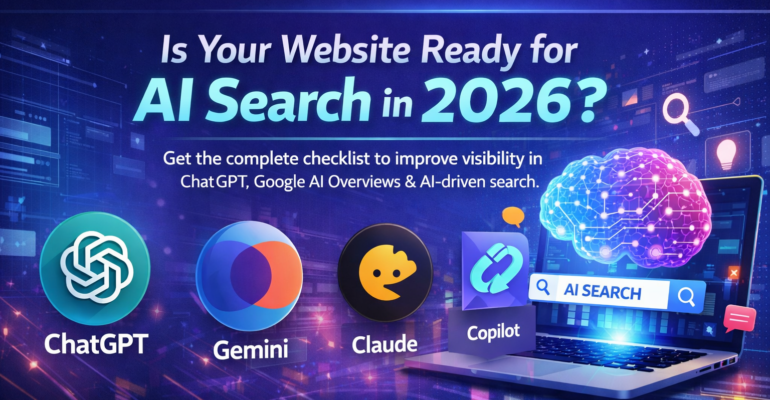
In 2026, users are no longer just typing keywords and clicking links. Instead, they are asking questions on AI platforms like ChatGPT, Google AI Overviews, Gemini, and Perplexity—and receiving instant, summarized answers.
This shift is redefining how websites gain visibility.
Ranking #1 on Google no longer guarantees traffic.
Being selected and cited by AI is the new goal.
So, the big question is:
Is your website ready for AI search visibility?
This blog provides a complete AI Search Readiness Checklist for 2026, helping you understand whether your website is optimized for:
- Google AI Overview visibility
- LLM platforms (ChatGPT, Gemini, Perplexity)
- Lead generation in a zero-click world
What is AI Search Optimization (LLM SEO)?
AI Search Optimization (also known as Generative Engine Optimization – GEO) is the process of structuring your website and content so that AI systems can:
- Understand your content
- Trust your authority
- Select your website as a source
- Summarize your content in answers
Unlike traditional SEO (which focuses on rankings), AI SEO focuses on:
Selection + Citation + Visibility
AI Search Readiness Checklist (2026)
1. Content Structured for AI Understanding
AI systems prioritize content that is easy to scan, parse, and summarize.
To optimize:
- Use proper H1, H2, H3 hierarchy
- Break content into bullet points and lists
- Keep paragraphs short (2–4 lines)
- Use simple, direct language
- Add summary sections
AI prefers content it can quickly extract and present as an answer
2. Intent-Driven Content (Not Just Keywords)
AI does not think in keywords. It thinks in user intent.
To align with AI:
- Target question-based queries
- Create “What,” “Why,” “How,” “Best,” and “Cost” content
- Use conversational phrasing
- Build topic clusters
Example:
Instead of “Shopify developer services”
Use → “How to hire a Shopify developer for your business?”
3. Topical Authority & Depth
AI favors websites that demonstrate deep expertise in a niche.
Build authority by:
- Publishing multiple blogs on related topics
- Interlinking pages strategically
- Covering beginner to advanced content
- Including case studies and insights
Your goal is to become a trusted source, not just a content publisher.
4. Schema Markup (Structured Data)
Schema helps AI understand your content context and relationships.
Implement:
- FAQ Schema
- Article Schema
- Organization Schema
- Breadcrumb Schema
This is critical for:
- Google AI Overviews
- Featured snippets
- Voice search
5. FAQ & Answer-Based Content
AI often extracts direct answers from FAQ sections.
Best practices:
- Add 5–8 FAQs per page
- Use natural language questions
- Keep answers concise and clear
6. E-E-A-T Signals (Experience, Expertise, Authority, Trust)
AI prioritizes content from credible and trustworthy sources.
Strengthen E-E-A-T by:
- Adding author names and bios
- Displaying company credentials
- Showcasing testimonials and case studies
- Maintaining HTTPS security
7. Technical SEO & Crawlability
Even in AI search, technical SEO remains foundational.
Ensure:
- Fast page load speed (Core Web Vitals)
- Mobile-first design
- Clean URL structures
- XML sitemap and robots.txt
- No broken links
8. Semantic SEO (Context Over Keywords)
AI understands meaning not just keywords.
Optimize for semantics:
- Use related terms and synonyms
- Include entities (brands, tools, locations)
- Avoid keyword stuffing
- Write naturally
9. Content Freshness & Updates
AI prioritizes updated and relevant information.
Maintain freshness by:
- Updating blogs regularly
- Adding recent statistics (2025–2026)
- Refreshing outdated content
10. High-Quality Backlinks & Mentions
Authority still matters in AI selection.
Focus on:
- Earning backlinks from niche websites
- Building brand mentions
- Publishing PR and guest posts
AI uses authority signals to determine which sources to trust
11. AI-Friendly Content Formatting
Structure content for easy extraction.
Include:
- Tables and comparison charts
- Definition sections
- Step-by-step guides
- Key takeaways
12. Zero-Click Optimization
Welcome to the zero-click era.
Optimize for:
- Answering queries directly within content
- Providing summaries at the top
- Structuring content for featured snippets
Goal: Be the answer, not just a link
13. Test Your AI Visibility
You can test your AI readiness easily.
- Ask ChatGPT or Gemini about your services
- Check if your brand is mentioned
- Monitor Google AI Overview results
14. Brand Presence Across Platforms
AI pulls signals from multiple platforms.
Ensure presence on:
- Google Business Profile
- YouTube
- Review platforms
Consistent branding builds trust.
15. Conversion & Lead Capture Readiness
Visibility without conversion is wasted effort.
Optimize for leads:
- Add strong CTAs
- Use lead forms and chat tools
- Optimize landing pages
- Enable WhatsApp integration
AI Search vs Organic Clicks: The Traffic Shift
| Factor | Traditional SEO | AI Search (2026) |
| User Behavior | Search → Click | Ask → Answer |
| Click Rate | High | Declining |
| Visibility | Rankings | AI Citations |
| Content Focus | Keywords | Intent & Context |
| Traffic Source | Google SERPs | AI Platforms |
| Conversion Path | Website visits | Direct answers |
Key Insight:
Traffic is shifting from click-based SEO → visibility-based AI search
Signs Your Website Is NOT AI-Ready
- Not appearing in AI answers
- No structured content
- Missing FAQs
- No schema markup
- Weak authority signals
How Brainium Can Help You Win in AI Search
At Brainium, we specialize in helping businesses adapt to the future of search.
Our AI SEO (GEO) services include:
✔ AI-ready content strategy
✔ Website structure optimization
✔ Schema implementation
✔ Authority and backlink building
✔ AI visibility audits
Get Your Free AI Search Readiness Audit Today. Discover how visible your website is in AI-driven search
Frequently Asked Questions
What is AI search optimization?
AI search optimization is the process of structuring content so AI systems can understand, select, and display it in responses.
How is AI SEO different from traditional SEO?
Traditional SEO focuses on rankings, while AI SEO focuses on being selected and cited by AI platforms
Why is my website not visible in AI search?
Your content may lack structure, authority, schema, or intent alignment.
How can I test my AI visibility?
Search your services on ChatGPT, Gemini, or Google AI Overview and check if your brand appears.
Will AI search reduce website traffic?
Yes, organic clicks may decline, but visibility and brand authority increase.